By: Dawn Lurie, John Mazzeo, and Alexander Madrak

In our recent post, Reading the Fine Print: USCIS Clarifies TPS Placeholder Dates Following Supreme Court Ruling, we discussed US Citizenship and Immigration Services’ (USCIS) use of temporary “placeholder” expiration dates for certain Temporary Protected Status (TPS) beneficiaries following the Supreme Court’s May 2026 decision and related litigation.
As of midday on July 17, 2026, USCIS again updated several of those placeholder dates. Employers with affected employees should review their reverification calendars and records accordingly. The updated placeholder dates include:
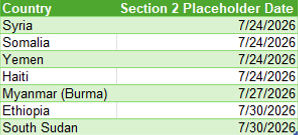
Notably, Haiti remains listed with a July 24, 2026 placeholder date. Because that date has not yet arrived, we do not currently expect a further Haiti-specific update today. However, given the pace of recent developments, employers should continue to monitor USCIS announcements closely.
As we noted in our prior post, these placeholder dates do not represent final decisions regarding TPS validity or employment authorization. Rather, they are temporary dates tied to ongoing litigation and agency implementation efforts and may be revised again with little notice.
Employers Should Also Take Note of Recent M-274 Updates
While much attention has focused on the rapidly changing TPS placeholder dates, employers should also review USCIS’s recent update to the M-274 Handbook for Employers (Sections 5.0 through 5.3), which reflects the employment authorization changes implemented under the One Big Beautiful Bill Act (OBBA). These changes have been detailed in prior BLOG posts on August 15, 2025 and October 30, 2025. USCIS noted that “In most cases, these developments have reduced or eliminated the automatic extension periods for qualifying TPS applicants and beneficiaries with TPS-based EADs.” Additionally, the Department of Homeland Security’s (DHS) interim final rule, effective Oct. 30, 2025, and USCIS’ implementation of H.R. 1 on July 22, 2025, also affected other EAD categories.
The revised guidance addresses automatic EAD extension rules, TPS-related work authorization, and reverification obligations that may affect employers independent of the ongoing TPS litigation. As a result, employers should review both the updated TPS placeholder dates, the USCIS TPS page and the revised M-274 guidance when assessing upcoming Form I-9 reverification requirements for affected employees. In some cases, the dates reflected in both USCIS’ TPS guidance and the automatic extension rules applicable to a particular EAD renewal application will need to be analyzed to determine an employee’s continuing work authorization.
As a refresher, the OBBA significantly changed the rules governing TPS-based EADs. Under the OBBA, TPS-based EADs are generally limited to a one-year validity period, with the possibility of a one-year extension if certain requirements are met. Individuals who had a TPS-based EAD renewal application pending as of July 22, 2025, may be eligible for an automatic extension of employment authorization for up to 540 days, but not beyond July 22, 2026. For certain TPS beneficiaries who filed EAD renewal applications between July 22, 2025, and October 30, 2025, the automatic extension period may instead be limited to one year from the EAD’s “Card Expires” date and remains subject to the July 22, 2026 statutory limitation implemented by the OBBA.
With several TPS-related employment authorization deadlines approaching and litigation continuing in Massachusetts challenging portions of USCIS’s implementation of OBBA, employers should expect additional developments in the coming weeks. The Seyfarth team will continue monitoring both the litigation and USCIS guidance and will provide updates as new information becomes available.
For more information, contact the authors or your Seyfarth relationship partner directly. Seyfarth’s Immigration Compliance & Investigations specialty group is recognized as a national leader in the field. Trusted by Fortune 100 companies and small businesses nationwide, the team provides strategic, practical guidance across the full spectrum of immigration compliance. The group advises on Form I-9 and E-Verify compliance; ICE inspections and worksite enforcement actions; internal immigration assessments and I-9 audits; DOL immigration-related wage-and-hour investigations; H-1B compliance; and DOJ’s IER and OCAHO anti-discrimination matters, including foreign sponsorship and export control/ITAR issues. The team complements its expertise in the Immigration Compliance and Investigations sector with its first-in-class litigation capabilities. For additional timely updates on all things immigration, subscribe to Seyfarth’s dedicated immigration blog at throughtheimmigrationlens.com.