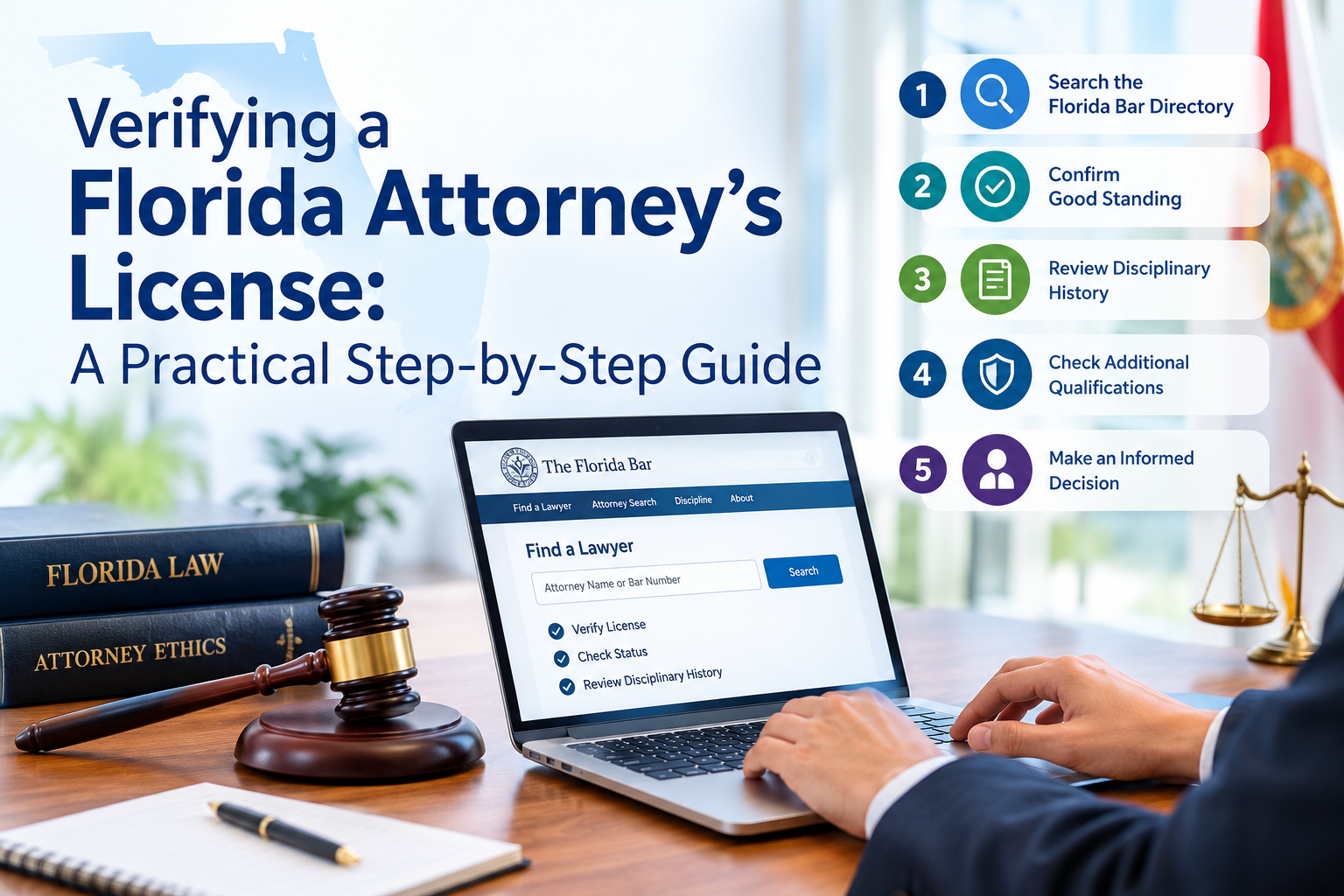
Before hiring a lawyer or relying on legal advice in Florida, confirm that the person is authorized to practice in the state. Checking Florida Bar status can help establish whether an attorney is currently eligible to represent clients and may reveal public information relevant to your decision. This basic step is especially important when you have received a referral, found a name online, or are preparing to share sensitive information or sign an agreement. A valid license is a baseline requirement, not a formality: it helps distinguish an authorized Florida attorney from someone whose authority may be limited or absent.
When people search for how to check attorney license in florida, official Florida Bar records should be the starting point. A directory entry, business card, law firm website, social media profile, or claim of professional credentials can help locate details, but none independently proves current authorization. Information may be outdated, incomplete, or presented inaccurately. Use the official record to match the lawyer’s full name and review the status shown, along with available public details such as disciplinary history. If names are similar or a record is unclear, confirm identity before drawing conclusions and contact the Bar through its official channels for guidance.
Verification is a practical screening step, not a complete assessment of legal representation. A license alone does not establish a lawyer’s experience, communication style, judgment, or suitability for a particular matter. Nor does an active status guarantee that advice will be correct or that a case will have a favorable outcome. After checking status, consider whether the attorney has relevant experience, ask how the proposed work will be handled, clarify fees and communication expectations, and review the engagement agreement carefully. Treat the official check as one part of an informed hiring decision, and revisit the record if circumstances change before representation begins.
For anyone researching how to check attorney license in florida, the best first step is The Florida Bar’s official online lawyer directory. It is the primary public source for checking whether a lawyer is listed with the organization and for reviewing the information associated with that listing. Begin by navigating to The Florida Bar’s own website and locating its lawyer directory or member search. Confirm that the website address belongs to The Florida Bar before entering information; search engines and third-party sites may display unofficial pages with similar names or designs.
Search using the attorney’s full name, including a middle name or initial if you know it. If you have the lawyer’s Florida Bar number, use that as well, since a unique identification number can help distinguish people with similar names and reduce the chance of selecting the wrong listing. Review the spelling and the order of the names you enter. If an initial search produces no result, try reasonable variations, such as omitting a middle initial, searching a former or alternate surname, or checking common differences in hyphenation and spacing. A small variation in how a name is recorded can affect search results.
A missing directory result should not, by itself, be treated as proof of misconduct or a conclusion that someone has falsely claimed to be an attorney. The name may be misspelled, changed, or entered differently, or the person may not be a member of The Florida Bar. In the latter case, the directory may not be the appropriate source for confirming that person’s professional status. Before drawing conclusions, check the details you have, try other reasonable search terms, and verify that you are using the official directory rather than an unofficial look-alike source. If uncertainty remains, contact The Florida Bar through contact information published on its official website and ask how to confirm the record.
Once you find a lawyer in the Florida Bar directory, compare the listing with the person you are considering hiring. Start with the attorney’s full legal name, including any middle initial, second surname, or suffix such as “Jr.” A small difference may reflect a naming variation, but it should be clarified rather than ignored. If the lawyer or an advertisement provides a Florida Bar number, confirm that the number belongs to the same person shown in the directory. These checks help ensure that you are applying the right result when researching how to check attorney license in Florida.
Next, compare the directory’s office location and contact details with the information the attorney or law firm has given you. Look for a consistent city, business address, telephone number, and other identifying information. Some lawyers maintain multiple offices or have recently moved, so a difference does not necessarily mean the listing is incorrect. It does, however, provide a reason to verify the details. A firm’s website can help you identify the attorney, learn how the name is presented professionally, and find current contact information, but treat it as a secondary reference. The official Bar record should remain the primary source for license status and identity.
Take particular care when several directory entries have similar names. Do not select a record based on a name alone, even if it appears to match an online profile or a referral. Use additional details—such as the Bar number, middle initial, suffix, office location, or practice information—to distinguish between attorneys. If uncertainty remains, contact The Florida Bar and ask how to confirm which record corresponds to the person you intend to hire. You can also call the lawyer’s office using contact details obtained independently and ask the attorney to confirm their Bar number and listing. Resolve discrepancies before relying on the record or making a hiring decision.
After locating a lawyer in The Florida Bar’s official directory, read the membership status rather than treating a matching name or bar number as proof of current authorization. The status describes the lawyer’s standing with the Bar at the time the directory information is checked. Because records can change, confirm the listing on the day you plan to hire or consult the attorney, especially if the matter is urgent. This is a key part of understanding how to check attorney license in Florida: verify both identity and current status.
An active status generally indicates that the member is eligible to practice law in Florida, subject to any conditions or restrictions shown in the record. Other labels can have materially different meanings. Inactive or retired members generally are not authorized to practice Florida law as active members; suspended members may not practice during the suspension; and disbarment means the person is no longer authorized to practice as a Florida Bar member. A person may also appear under another administrative or special status. Do not infer permission from a label alone, or assume that every non-active category has the same effect.
Use the directory’s definitions and any linked disciplinary or membership details to interpret the entry. If the status is unclear, appears inconsistent, or does not explain a restriction, contact The Florida Bar directly before relying on the listing. Ask whether the attorney is currently eligible to practice and whether the record identifies limitations relevant to your matter. Keep in mind that an attorney licensed in another state is not automatically authorized to practice Florida law. Limited exceptions may apply under Florida rules, such as certain approved temporary or pro hac vice appearances, but those exceptions do not amount to general Florida licensure. Confirm the specific authorization rather than relying on an out-of-state license, a firm website, or an old directory screenshot.
After confirming that an attorney is listed with The Florida Bar, review the attorney’s official profile for any disciplinary information or links to related Bar records. These materials can provide context beyond a license status, including whether a public disciplinary action was imposed and what the outcome was. For a practical approach to how to check attorney license in florida, use the Bar’s own records as the primary source and verify that the profile belongs to the attorney you are researching.
Read each record carefully rather than treating every reference to a complaint as proof of misconduct. A complaint may be pending, may have been dismissed, or may not have resulted in a public finding. A final public disciplinary decision is different: it reflects an outcome reached through the applicable process and may describe the conduct at issue. The record should state the status and disposition, but terminology can be unfamiliar, so avoid drawing conclusions from a brief search result or an isolated entry.
Check the dates, the stated outcome, and any sanction listed. Disciplinary information is time-sensitive: a matter may have been updated, resolved, or superseded by a later order. If you find a reference without a clear explanation, look for the underlying official document or contact The Florida Bar for guidance on locating and understanding its records. Do not rely solely on an old third-party page, a search-engine snippet, or an incomplete profile; those sources may omit later developments or lack important context.
A record with no publicly displayed discipline is useful information, but it should not be read as an endorsement or a guarantee of an attorney’s competence, experience, responsiveness, or suitability for a particular case. Public records may not address every concern, and professional fit depends on your needs and the lawyer’s relevant practice background. Use disciplinary history as one part of a broader review, alongside direct questions about experience, fees, communication, and case strategy. If a record raises a concern, ask the attorney for an explanation and assess the response before deciding whether to proceed.
Once you have located an attorney’s official Florida Bar profile, use it to verify practical contact details before relying on information from advertisements, directories, or search results. Compare the listed office address and telephone number with the lawyer’s website and any documents you have received. If the information differs, contact the office using a number obtained from a reliable source and ask which location and contact details are current. This step can help you avoid misdirected communications and confirm that you are dealing with the attorney or firm you intended to reach.
Review the profile’s stated areas of practice as a starting point, not as a guarantee of specialized qualifications or a particular level of experience. Lawyers may describe their work broadly, and practice descriptions can vary across profiles and marketing materials. When considering how to check attorney license in Florida, distinguish the lawyer’s current status and official profile information from claims made in promotional content. A listing that mentions family law, criminal defense, or estate planning does not, by itself, establish certification in that field.
If formal recognition in a specialty is important to your decision, consult official Florida Bar certification information. The Bar’s certification program identifies attorneys who have met specified requirements in an approved area; it is distinct from an attorney simply stating that they focus on a type of case. Check the relevant official records for the specialty you care about, and confirm that any claimed certification is current. Do not rely solely on a website badge, biography, or advertisement, since promotional wording may not explain the exact status or scope of a credential.
Finally, contact the attorney’s office and ask directly about experience with the legal issue you face. Describe the kind of matter, its current stage, and any important deadlines, then ask how frequently the lawyer handles similar cases and what role the lawyer would personally play. You can also ask who will work on the matter, how communication is handled, and whether the firm has relevant experience in the court or jurisdiction involved. Clear, specific answers can help you assess fit, but they are not a substitute for reviewing the engagement terms and asking questions before hiring counsel.
If an initial search does not produce a matching record, do not assume immediately that the person is unlicensed, but do not rely on an explanation without checking it. First, review the information you entered. Confirm the spelling of the first and last name, and try known variations, such as a middle name, middle initial, hyphenated surname, former surname, or alternate spelling. A minor difference can affect search results. If the person provided a Florida Bar number, search using that number as well as the name. When considering how to check attorney license in Florida, use the official Florida Bar directory rather than relying only on search engines, commercial listings, or a profile supplied by the person.
Next, compare the directory entry with details the person has provided. Check the full name, Bar number, business address, and other available identifying information against the engagement letter, email signature, law firm website, or business card. A similar name alone is not enough to establish that a directory record belongs to the person contacting you. Likewise, an address or firm name that differs from an online listing may warrant clarification, but it does not by itself prove misconduct. Ask the person to explain any discrepancy and provide information that you can independently verify through official sources.
If uncertainty remains, contact The Florida Bar using contact details published on its official website. Explain what you searched, provide the name and Bar number if available, and ask how to confirm the person’s status or resolve a possible identity mismatch. Avoid using phone numbers or links sent only by the person whose credentials you are checking. There can be innocent reasons for a mismatch, including a name change, a data-entry issue, or outdated information. Still, if someone claims to be a Florida attorney and you cannot verify the claim, pause before paying fees, signing an agreement, or sharing sensitive documents. Proceed only after the discrepancy has been resolved through official channels and you are satisfied that you are dealing with the correct person.
Knowing how to check attorney license in florida is an important first step, but a valid license alone does not determine whether a lawyer is the right fit for your matter. Before hiring, clarify exactly who will represent you and who else may work on your case. The lawyer you meet may not handle every task personally, so ask whether associates, paralegals, or other staff will be involved and how their work will be supervised. Confirm the responsible attorney’s name and role in writing.
Request a written fee agreement before work begins. It should explain how fees are calculated, whether the lawyer charges hourly, a flat fee, or on another basis, and what expenses you may be responsible for. Ask when invoices will be sent, how payment is due, and whether an advance deposit is required. Make sure you understand what services the quoted fee covers and what circumstances could lead to additional charges. Raise any unclear language before signing, and keep a copy of the final agreement.
Discuss the scope of the representation so you know what the lawyer will—and will not—do. For example, confirm whether the engagement includes negotiations, court appearances, or an appeal, if relevant. Ask how the firm will communicate with you, how quickly you can generally expect a response, and whom to contact with routine questions. Discuss important deadlines, how you will be notified about developments, and whether the lawyer has identified any potential conflicts of interest that require further discussion.
Use care when receiving instructions to transfer money or change payment details. Verify that payment instructions come from the law firm through a trusted channel, and do not rely solely on an unexpected email or message. If a request seems unusual, contact the attorney using independently verified contact information, such as a number obtained from the firm’s established website or prior paperwork—not details in the suspicious message. Confirm the request before sending funds. Clear answers about representation, fees, communication, and payment help you make an informed hiring decision.
When you verify an attorney’s information, record the date you searched The Florida Bar’s official directory. A saved note or screenshot can help you remember what the listing showed at that time, including the attorney’s name, Bar number, office details, and license status. Keep only information relevant to your personal matter, and store it securely, particularly if it contains contact details or other sensitive information.
License information is a snapshot, not a guarantee of future status. An attorney’s standing, contact information, or disciplinary record may change after your search. For that reason, note the exact date alongside any saved directory information rather than relying on an old printout as proof of current eligibility. If you are learning how to check attorney license in Florida, treat the official directory as a resource to revisit, not a one-time check.
Consider searching again if your legal matter continues for an extended period, if the attorney’s role or practice arrangements change, or if you become concerned about the services you are receiving. It can also be sensible to confirm the listing before a major engagement, such as signing a substantial fee agreement, transferring significant funds, or entrusting the lawyer with an important filing. A fresh check may help you identify updates that were not present when you first reviewed the record.
Pay attention to whether the identity details still match the person you hired. Names can be similar, firms can change, and directory entries may not answer every question about who is handling your matter. If a disciplinary entry appears, read the official information carefully and note its date and nature; do not assume that a brief listing tells the entire story. Keep copies of relevant official records and any correspondence about your inquiry.
Use The Florida Bar’s current official directory for verification, and contact the Bar directly when a status, disciplinary entry, or identity match is unclear. Direct confirmation is preferable to relying on third-party listings or assumptions, especially before making an important legal decision.
FAQs: Verifying a Florida Attorney’s License — A Practical Step-by-Step Guide
These frequently asked questions explain how to verify a Florida attorney’s license, check disciplinary history, confirm current standing, and identify warning signs before hiring a lawyer. They are suitable for a legal information article on How to Verify a Florida Attorney’s License and Standing.
Frequently Asked Questions
1. How can I verify a Florida attorney’s license?
Visit the official Florida Bar Find a Lawyer directory. Search by the attorney’s first and last name or Florida Bar number. Review the attorney’s profile to confirm their identity, admission date, and current membership status.
2. Is The Florida Bar’s attorney directory free to use?
Yes. The public can use the online directory to look up attorneys and review available professional information, including bar membership status and disciplinary history.
3. How do I check whether a Florida attorney is in good standing?
Search for the attorney in the official directory and look for the membership status displayed on their profile. A status such as “Member in Good Standing” indicates good standing, while other statuses may affect eligibility to practice. If the information is unclear, contact The Florida Bar for confirmation.
4. Can I verify an attorney using their Florida Bar number?
Yes. The Florida Bar directory supports an exact-match search by bar number. This can help distinguish attorneys with similar names and confirm that the profile belongs to the lawyer you intend to hire.
5. How can I check a Florida attorney’s disciplinary history?
Open the attorney’s profile in The Florida Bar directory and look for the 10-Year Discipline History section. If disciplinary information is available, review the listed sanctions, action dates, reference numbers, and related court documents. For records older than 10 years, contact The Florida Bar directly.
6. Does a disciplinary record automatically mean an attorney is unqualified?
No. A disciplinary record should be evaluated in context. Review the nature of the misconduct, the date, the sanction imposed, and any subsequent developments. A record does not automatically establish that an attorney is currently ineligible to practice, so check the attorney’s present status separately.
7. What should I do if an attorney’s name does not appear in the directory?
Double-check the spelling, try the attorney’s full legal name, and search by Florida Bar number if available. If no matching record appears, contact The Florida Bar to clarify the situation before hiring the individual. Some limited exceptions to ordinary Florida Bar membership requirements exist, so a missing listing alone is not conclusive proof of unauthorized practice.
8. Can an attorney licensed in another state practice law in Florida?
Generally, attorneys must be members of The Florida Bar to practice law in Florida. However, certain limited exceptions may apply under Florida law and court rules. Ask the attorney to explain the legal basis for handling your matter in Florida and verify any claimed authorization with the appropriate authority.
9. How can I confirm an attorney’s education and experience?
Review the attorney’s official Bar profile for available information, including law school and admission date. Ask about their experience handling cases similar to yours, relevant outcomes, and professional qualifications. You can also use The Florida Bar’s Board Certified Lawyer directory to check whether an attorney holds a recognized specialty certification.
10. What is a Certificate of Good Standing in Florida?
A Certificate of Good Standing is an official document that confirms an attorney’s qualifying membership status with The Florida Bar. The Florida Supreme Court Clerk’s Office provides information about obtaining certificates for eligible attorneys. Check the attorney’s current status before requesting a certificate.
11. How often should I verify a Florida attorney’s license?
Check the attorney’s status before hiring them, particularly when signing a representation agreement or paying a retainer. For lengthy legal matters, consider checking again if concerns arise or the attorney’s ability to continue representing you becomes uncertain.
12. What should I do if I suspect someone is practicing law without a Florida license?
Document the person’s name, communications, website, and any claims they made about their legal qualifications. Contact The Florida Bar’s Unlicensed Practice of Law Department for guidance. The Bar also provides an official lawyer complaints and discipline resource for reporting potential misconduct.
13. Does a valid Florida attorney license guarantee good legal representation?
No. A valid license confirms a form of professional authorization, not the quality of every legal service. Before hiring an attorney, evaluate their relevant experience, communication, fees, responsiveness, and approach to your case, in addition to checking their licensing and disciplinary records.