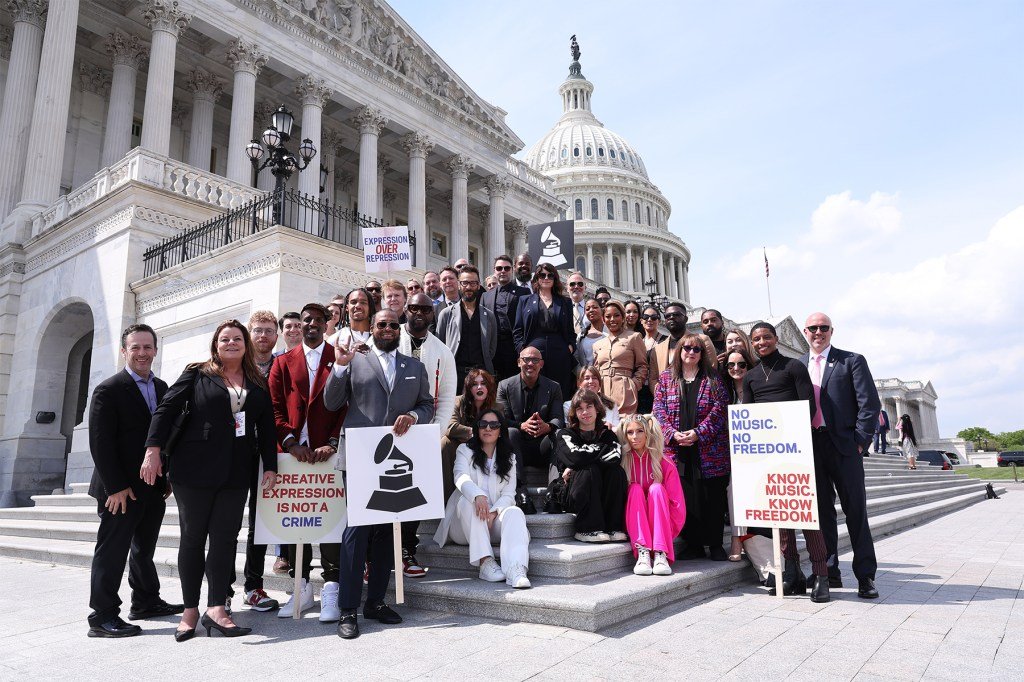
When Maryland lawmakers passed new legislation restricting how rap can be used in criminal cases, it was the latest victory in a five-year effort to limit a practice that critics say hurts free speech and stokes racial bias.
Prosecutors have long cited hip-hop lyrics as evidence to help win convictions against the artists who wrote them, doing so in more than 800 cases over the past four decades. Though the tactic is used more often against amateurs, big names like Boosie Badazz, Bobby Shmurda and the late Drakeo the Ruler have lyrical indictments, as have Young Thug and Lil Durk in more recent cases.
A growing awareness of the practice has led a chorus of critics — from top artists to industry groups to academics — to speak out against it over the past few years. In a Supreme Court brief filed just last month, attorneys for Travis Scott told the justices that merely “engaging in rap music should not be a death sentence.”
Critics say that using rap as evidence unfairly treats it as a literal statement of fact instead of creative expression, denying hip-hop the full First Amendment protections afforded to other art forms. They also cite empirical studies showing that rap can inject racial bias into court cases, tapping into existing prejudices against young Black men.
Starting at the beginning of the decade, lawmakers began paying attention. Legislators across the country have been limiting when lyrics can get into court, first with a bill that almost passed in New York, then with a groundbreaking California law. And with the support of stars like Jay-Z and Drake and industry bigwigs like Kevin Liles, advocates are now turning their sights on other states and to the federal level.
To get up to speed, here’s a timeline of the battle against rap on trial.
-
November 2021: New York Proposes First-Ever Rap Bill
A pair of New York state lawmakers, Sen. Jamaal T. Bailey and Sen. Brad Hoylman, introduce a first-of-its-kind bill dubbed Rap Music on Trial — a bill that, if enacted, would tightly restrict when hip-hop can enter the courtroom.
The bill is not a ban. It would allow lyrics to be admitted, but only if the prosecutors can show they are directly literal statements, which critics say is rarely the case: “Hip-hop lyrics are treated with unequal weight,” Bailey tells Billboard at the time. “This is about the right for an artist have their work treated as art.”
Though Bailey and Hoylman’s bill passes the state senate, it doesn’t end up securing full passage by the end of the legislative calendar. But, it creates a framework for future efforts to restrict rap-as-evidence, both in New York and elsewhere.
-
January 2022: Superstar Artists Speak Out
Jay-Z, Meek Mill, and a slew of other artists sign a letter endorsing Hoylman and Bailey’s legislation, co-authored by powerhouse attorney Alex Spiro and Erik Nielson, an academic who wrote a groundbreaking book on the subject. Though artists have occasionally voiced opposition, the letter is by far the biggest effort yet from major stars.
“This tactic effectively denies rap music the status of art and, in the process, gives prosecutors a dangerous advantage in the courtroom,” reads the letter from Jay-Z and the other stars. “By presenting rap lyrics as rhymed confessions of illegal behavior, they are often able to obtain convictions even when other evidence is lacking.”
-
May 2022: Young Thug Hit With Lyric-Laced Indictment
When chart-topping rapper Young Thug is charged with running a violent Atlanta street gang, prosecutors heavily quote from his music— including the 2018 track “Anybody,” in which he raps “I never killed anybody/ But I got somethin’ to do with that body.”
A few months later, Fulton County DA Fani Willis offers no apologies for doing so: “If you decide to admit your crimes over a beat, I’m gonna use it,” Willis said. “I have some legal advice: don’t confess to crimes on rap lyrics if you do not want them used.”
-
July 2022: RAP Act Introduced in Congress
A bill restricting lyrics in federal criminal cases, The Restoring Artistic Protection (RAP) Act, is introduced in Congress for the first time, drawing public support from a range of music industry executives and advocacy groups. “The bias against rap music has been present in our judicial system for far too long,” says Harvey Mason Jr., CEO at the Recording Academy.
Sponsored by Congressmen Hank Johnson and Jamaal Bowman, the RAP Act requires prosecutors to show four things before they use lyrics: That were meant literally; that they refer to the specific crime; that they address a disputed fact in the case; and that they cannot be avoided by using other evidence.
“We cannot imprison our talented artists for expressing their experiences nor will we let their creativity be suppressed,” Bowman says at the time.
-
September 2022: California Enacts Groundbreaking Law
California takes the leap, becoming the first state in the country to enact legislation restricting when prosecutors can use rap and other creative expression as evidence in criminal cases.
The law, the Decriminalizing Artistic Expression Act, bars such lyrics from the courtroom unless they are directly relevant to the facts of the case and won’t “inject racial bias into the proceedings” — one step further than the New York and federal proposals. “Artists of all kinds should be able to create without the fear of unfair and prejudicial prosecution,” Gov. Gavin Newsom says.
-
June 2023: Louisiana Adds its Own Rap Law
In becoming the second state to limit creative expression in criminal cases, Louisiana takes different approach than California.
So-called character evidence — testimony or documents showing a person has a propensity to behave in a certain way — is considered highly prejudicial and is almost always inadmissible to prove someone is guilty of a specific crime.
To address the rap-on-trial issue, Louisiana updates its character evidence rules to explicitly add “creative or artistic expression” to the list of materials that are generally not admissible. But like all such evidence, the law says lyrics can still be used to show proof of motive, opportunity, intent and other elements of a criminal case.
-
November 2023: Judge Allows Young Thug’s Lyrics
An Atlanta judge rules that Young Thug’s rap lyrics can be used as evidence against him and other alleged gang members in their upcoming criminal trial, rejecting arguments that doing so would violate the First Amendment.
Thug’s lawyers blast the tactic, but as is often the case, the judge allows the lyrics to be read to the jury during his trial: “They’re using the songs to prove other things your clients may have been involved in,” the judge says. “I don’t think it’s an attack on free speech.”
-
October 2024: Lil Durk Charges Include His Lyrics
Lil Durk is arrested and charged with ordering his OTF crew to murder a rival rapper in a 2022 shooting that left another man dead — and that he celebrated the attack on a subsequent song.
In charging documents, federal prosecutors quoted lyrics from a song called “Wonderful Wayne & Jackie Boy” that allegedly referenced the shooting, claiming Durk “sought to commercialize” the killing by “rapping about his revenge.”
Just one problem: Durk’s lawyers quickly pointed out that the track was released “seven months before the incident even happened.” And a few months later, prosecutors filed an updated version of the case that deleted all reference to the “Wonderful” lyrics.
-
July 2025: Federal Lyrics Law Reintroduced
After earlier failed efforts in 2022 and 2023, the federal RAP Act is reintroduced in Congress for a third time with twenty cosponsors including prominent lawmakers like Alexandria Ocasio-Cortez.
“This legislation is long overdue,” Reps. Hank Johnson, the bill’s co-sponsor, says at the time. “The government should not be able to silence artists simply because they write, draw, sing, or rap about controversial or taboo subjects.” The bill remains pending before 119th Congress.
-
February 2026: Durk’s Lyrics Cleared for Trial
As Lil Durk’s federal trial on murder-for-hire charges nears, a judge rules that prosecutors can still introduce some lyrics to the jury – from his Nardo Wick collaboration “Who Want Smoke??” and from “Ahhh Ha,” a track that hit No. 4 on Hot R&B/Hip-Hop Songs.
The judge rules that those lyrics can be used to try to show the Chicago rapper’s motive for placing a bounty on his rival Quando Rondo, which prosecutors say he did in retaliation for the 2020 killing of his close friend King Von. But the judge also bars lyrics that merely depict Durk’s crew as violent and lack any direct connection to the facts of the case.
-
April 2026: Maryland Passes PACE Act
Maryland becomes the third state to restrict when prosecutors can cite rap lyrics as criminal evidence, adopting a similar approach to the proposed federal RAP Act.
The Protecting Artists’ Creative Expression (PACE) Act allows prosecutors to use rap lyrics and other “creative expression” only after a judge decides that it meets certain strict requirements — including that it was intended as a literal statement about the facts of the case. It doesn’t include California’s language about “injecting racial bias.”
Industry exec Kevin Liles, a Baltimore native who championed the new law, says they’re not done yet: “We’re turning our attention to New York State next, and we hope to have two bills passed this year.”