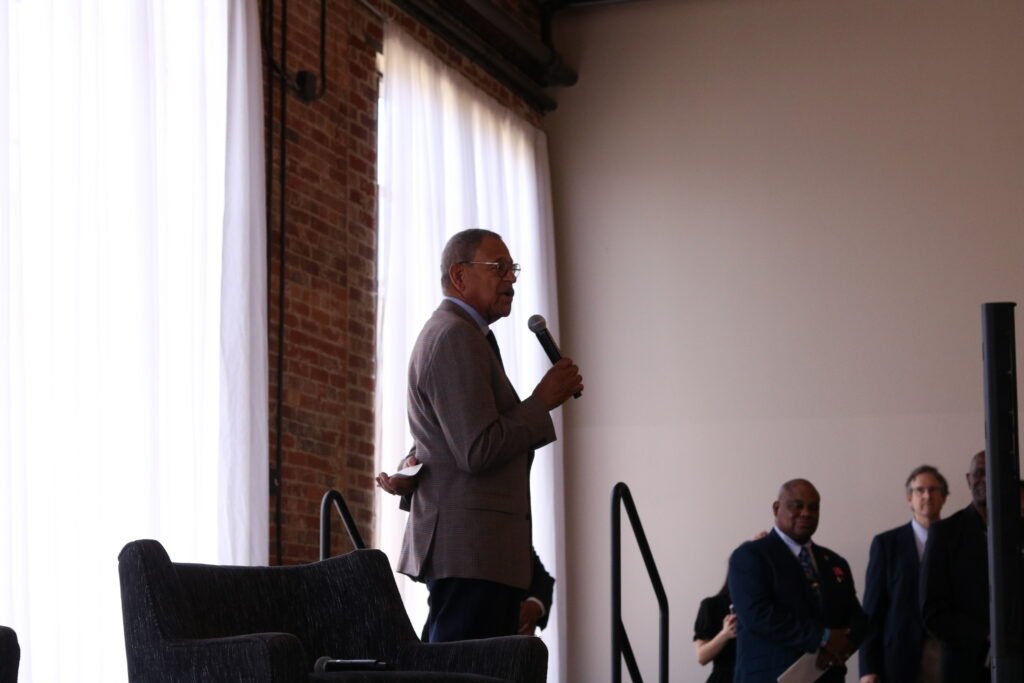
U.S. Rep. Sanford Bishop speaks at a rally for U.S. Sen. Jon Ossoff on Aug. 18, 2026. Maya Homan/Georgia Recorder
At first glance, a largely rural district that stretches across 30 counties in middle and southwest Georgia might not seem like friendly turf for a Democrat.
But Congressman Sanford Bishop, a moderate Albany Democrat, has comfortably fended off GOP attempts to flip the seat in recent years. Bishop has represented the 2nd Congressional District for more than three decades and is currently the longest-serving member of Georgia’s congressional delegation. The 79-year-old is expected to win another two-year term this fall.
Bishop is also the only Georgia Democrat to represent a congressional district that falls outside of metro Atlanta, and his district’s location, bordered by Republican-controlled districts to the north and east, makes it a prime candidate for partisan gerrymandering.
US Supreme Court limits use of race in congressional district remaps, diluting Voting Rights Act
Earlier this year, Georgia Gov. Brian Kemp urged lawmakers to redraw the state’s political maps ahead of the 2028 election after a U.S. Supreme Court ruling weakened part of the Voting Rights Act, and the 2nd Congressional district was widely seen as the likeliest target. Republican leaders in the Georgia Legislature ultimately backtracked on those redistricting plans, but lawmakers could still decide to redraw the boundaries in order to make Bishop’s district more friendly to a Republican candidate.
However, residents of Bishop’s district from across the political spectrum say drawing Bishop out of his seat is likely to be easier said than done.
‘It’s not conservative, it’s not liberal’

If you drive through southwest Georgia, it’s hard not to notice the fields of cotton and peanuts that blanket the landscape during the growing season. Logging trucks and 18-wheelers roar by on the roadways, and vast irrigation systems stand over rows of crops.
The district is an agricultural hotspot in the state, accounting for 19% of Georgia’s agriculture sales according to the U.S. Department of Agriculture’s 2022 census.
It includes denser areas as well, encapsulating cities like Albany and most of Columbus and Macon. Though the district hasn’t been majority-Black since 2021, Black voters still make up nearly half of the district’s voting age population, according to Georgia’s legislative and congressional reapportionment office.

Seth Clark, a former Macon-Bibb County commissioner and Democrat who briefly launched a bid for lieutenant governor this year, said part of what makes the 2nd Congressional district unique is that the communities within it don’t always fall neatly along partisan lines.
“It’s not conservative, it’s not liberal,” Clark said. “There’s a lot of people that are used to voting for Democrats and Republicans at the same time in this area.”
That swingy quality is perhaps more pronounced in Georgia’s 2nd Congressional District than anywhere else in the state. Of the state’s five “pivot counties” — places where voters chose former President Barack Obama in both 2008 and 2012 and President Donald Trump in 2016, according to Ballotpedia — four are in Bishop’s district. The district is also home to two of five Georgia counties that backed both Republican Gov. Brian Kemp and Democratic Sen. Raphael Warnock in 2022, according to results from the secretary of state’s office.
The appetite for moderate politics is present even among loyal party members. At a rally for U.S. Sen. Jon Ossoff in Columbus, real estate agent and Greater Beallwood Baptist Church pastor Adrian Chester said members of his community are increasingly squeezed by rising costs of living that stem from tariffs, increased gas prices and mounting cost of groceries.
The district is one of the poorest in Georgia, with a median income of under $52,000 and 17% of families falling below the federal poverty level, according to the Census Bureau’s 2024 American Community Survey. That makes the rising cost of living all the more keenly felt here.
Democrats in the area, Chester said, should keep their focus on affordability issues and stay away from hot-button intra-party divides over ideology.
“It’s time for us to move away from this whole ‘democratic socialism,’ things of that nature,” he said. “Let’s not be distracted. Don’t allow the Republican Party to dictate what our talking points are and what’s important to our people.”

Philip Kurland, a Plains resident who runs a political merchandise store called Plains Trading Post in the late President Jimmy Carter’s hometown, said the region boasts a number of politicians who enjoy cross-party support because of their strong presence in the community and responsiveness to their constituents’ needs.
“We want people that represent us and really don’t care if they’re Republican or Democrat,” Kurland said.
‘A true moderate’
A lawyer by training and self-proclaimed “city boy,” Bishop acknowledged that he had a lot to learn when he was first elected to represent the district in 1992. He has since become the dean of Georgia’s congressional delegation.

A member of the centrist “blue dog Democrat” caucus, which emphasizes fiscal responsibility, Bishop has championed Democratic causes while also breaking with his party at times.
“Congressman Bishop is a true moderate, and he’s been a true moderate his entire tenure in Congress,” said Andra Gillespie, an associate professor of political science at Emory University.
Bishop’s congressional office did not respond to multiple interview requests.
Bishop is also a ranking member of an appropriations subcommittee focused on agriculture and rural development, and his longstanding relationships and institutional knowledge in Congress have allowed him to direct funds and resources to the district. During his tenure in office, Bishop has secured over a billion dollars in federal grants and loans for local communities across southwest Georgia, his office boasts on his website.
“I promised in 1992, that I would be like a sponge,” he told a crowd at the American Peanut Shellers pre-harvest meeting in Albany last month. “I would soak up that information and try to use it and arm myself so that I could be your advocate.”
“You have helped me, and I am grateful,” he added.
That’s not to say that he hasn’t had bruising re-election fights. In 2010, he narrowly beat Republican challenger Mike Keown with 51.4% of the vote, the closest margin in his career. In 2022, he survived another tough contest after the district was redrawn by the GOP-controlled Legislature to be slightly more favorable for a Republican candidate, but he ultimately defeated Republican Chris West with nearly 55% of the vote. He will face Republican Matt Day in November.
Part of Bishop’s success as a congressman, Clark said, is likely due to how attentive he is to the needs of his district, especially among constituents whose concerns are often less “nationalized” than those in other parts of Georgia.
“You’re not going to turn on MSNBC tonight and see Sanford Bishop on there,” Clark said. “But you might go to the high school football booster club, and he might be there. And that really matters.”
A deep knowledge of agriculture and the needs of farmers is also key to representing the district. Jimmy Wilson, a senior vice president at AB&T bank who attended the American Peanut Shellers’ meeting, said farmers across the state were desperately waiting on Congress to pass a long-overdue update to the farm bill, which he said would help stabilize farmers’ income amid rising costs, and modernize pricing standards that he says haven’t been adjusted in roughly 30 years.
US House passes ‘skinny’ farm bill that keeps big GOP cuts to food assistance
“We’re still working under a farm bill that was designed in 2018, so we need a current farm bill with current price support structures,” he said.
Bishop was one of only 14 Democrats who crossed party lines to advance the bill out of the House, and the only Democrat in Georgia to do so. The bill is now tied up in the U.S. Senate.
Sandra Sallee, the Grady County Democratic Party chair, said that even people in her deep-red area can appreciate the work Bishop has done to bring funding and resources to the area.
“I think that there are people who grudgingly give him their respect, if not for his political leanings, but for the fact that they see, ‘oh, we got our street paved because Democrats worked for it and Sanford Bishop worked for it,’” Sallee said.

State Rep. Gerald Greene, a Cuthbert Republican who has represented his southwest Georgia House District since 1983, said he has often worked with Bishop to help address the concerns of their shared constituents.
“Whatever benefits the people, then it benefits both of us,” he said. “It’s real easy to work with someone that has been involved in government as long as he has.”
What would it mean for the district to be redrawn?
Cheers erupted at the state Capitol when Speaker Jon Burns, a Newington Republican, announced at a press conference this summer that Republicans would not move forward at that time with redrawing political maps for the 2028 election as instructed by the governor.
Georgia Republican lawmakers drop plans to redistrict, citing pending legal cases
The potential for redistricting intensified after a U.S. Supreme Court ruling earlier this year diluted a key provision of the 1965 Voting Rights Act by ruling that plaintiffs must prove that there was “intentional racial discrimination” in order to get gerrymandered districts overturned.
Though redistricting is generally conducted once every 10 years following the U.S. census, that decision kicked off a spate of mid-cycle redistricting among Southern states seeking to pass maps that were more favorable to Republican candidates.
In Georgia, those efforts have so far been unsuccessful. But Democrats quickly cautioned that the decision should be seen more as a delay than a cancellation.
“I think most people presume that we are going to go back into special session after the election is over,” said Rep. Michelle Au, a Johns Creek Democrat.

Republican state lawmakers, she added, likely held off on their plans to avoid energizing Democratic voters by redrawing the maps ahead of a big election. But depending on how the election results play out, lawmakers could call another special session to address redistricting after the midterms or take it up during next year’s regularly scheduled legislative session, which begins in January.
“I have no doubt that they are going to do it because why wouldn’t they, right?” Au said. “I think the only question mark for most people is just when.”
Federal appeals court voids ruling that Georgia’s political maps violated Voting Rights Act
For now, all eyes are on the courts. Last month, 11th U.S. Circuit Court of Appeals sent a 2021 lawsuit over Georgia’s legislative and congressional maps back to a federal district court, ordering the judge to reexamine the case in light of the new Supreme Court precedent.
Multiple political science experts and voting rights advocates say it seems likely that Republicans in the state Legislature will attempt to redraw the maps again ahead of the 2028 election, which could include newfound efforts to target Bishop’s seat and draw Black voters into other districts.
“Although it’s not technically competitive, it’s the most competitive one we have in Georgia as a congressional district,” said Ken Lawler, the chair of Fair Districts Georgia, an organization that advocates for a nonpartisan redistricting process.
During the 2024 general election, the most recent contest in which Bishop was on the ballot, he won re-election with over 56% of the vote. That margin, and the district’s location between other Republican-controlled districts, Lawler added, make it “a target for manipulation” which could ultimately weaken the electoral power of Black voters in southwest Georgia.
‘Prepared for the worst’: Black lawmakers brace for losses as Georgia GOP eyes new political maps
The new Supreme Court precedent also makes it much more difficult for courts to intervene in gerrymandering disputes.
“Because of the old interpretations of Section Two of the Voting Rights Act, people were going to be somewhat loath to redraw those district lines because you could get credibly accused of trying to disenfranchise Black voters,” Gillespie said. “Right now, you can change the lines on account of partisanship and not really be held to account about what the racial impact would be on African American voters.”
Kurland, the owner of Plains Trading Post, said he doubted Bishop would be easily defeated, comparing him to figures like the state lawmaker Greene, who have repeatedly survived tough election cycles in districts not seen as favorable to their party.
“Bishop has really come through for this district,” he added. “Even if they reapportioned it, I can’t imagine him not carrying it away.”
What’s next for redistricting?
Burns, the state House speaker, said in a statement that lawmakers have not considered any proposals for reapportionment, but left the door open on redistricting.
“Given recent court decisions and ongoing litigation, we are continuing to examine the legal landscape not only here in Georgia, but across the country,” he said.
But Charles Bullock, a political scientist at the University of Georgia, who has written a book on redistricting, says Bishop’s district may not end up being the GOP’s top target.
“These are rural folks who very much appreciate what Bishop has done and the influence he has,” Bullock said. In his conversations with House leadership, he added, “at least one of them has said, rather than going after Bishop, maybe Republicans would look to trying to pick up a district in metro Atlanta.”
If Republicans do push forward with redistricting efforts, they will have to consider all of these factors, and may even need to drum up enthusiasm within their own ranks.

State Rep. Mike Cheokas, an Americus Republican who represents a handful of rural counties just south of Columbus that fall within Bishop’s congressional district, expressed relief that Republican leadership in the state House and Senate chose not to pursue redistricting during the June special session.
“This is an election year, and I’ve got opposition,” he said. “I sure didn’t want to be in Atlanta drawing district lines when I needed to be out campaigning.”
While Cheokas said he didn’t feel there was much appetite for redistricting during the special session, he didn’t rule it out for later this year.
“I’m not saying that it ain’t going to happen in the future, but I am saying that when it does happen — if it does happen — it’s complicated.”