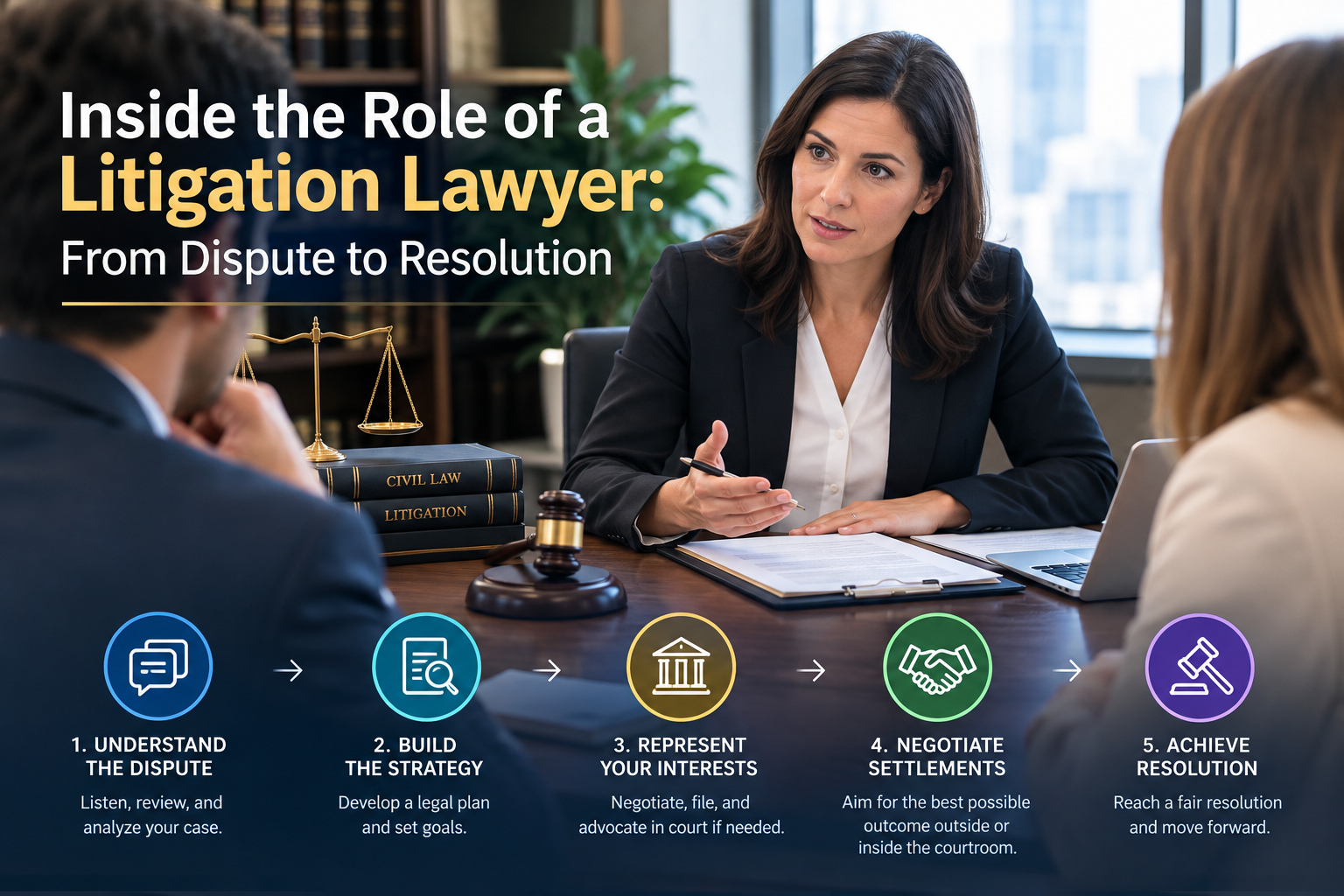
A litigation lawyer is a legal professional who advises and represents clients involved in a dispute that may be resolved through negotiation, formal legal proceedings, or a trial. The term describes the lawyer’s role in handling a contested matter, rather than a particular side or outcome. A litigator may represent a plaintiff who brings a claim, a defendant who responds to it, or another party with an interest in the dispute. Their work can include assessing the legal issues, explaining available options, and helping a client decide how to proceed.
Litigation refers to the process of resolving legal disputes. A litigation lawyer is the advocate who guides and represents a client throughout that process. This may involve gathering facts, reviewing documents, researching applicable law, preparing legal filings, communicating with opposing counsel, and presenting arguments. Many disputes settle before reaching trial, so litigators often negotiate or participate in alternative dispute resolution. If a case continues into court, they may prepare witnesses, introduce evidence, and argue the client’s position before a judge or jury.
The exact scope of a litigation lawyer’s responsibilities varies by jurisdiction, practice area, and case. Some focus on commercial, employment, family, personal injury, or other disputes; others handle a broad range of matters. Court procedures, professional rules, and available remedies also differ across legal systems. For that reason, the title alone does not specify which services a particular lawyer provides or whether they regularly conduct trials. A person facing a dispute can ask a prospective lawyer about their relevant experience, the likely stages of the matter, and the approaches available. In general, a litigation lawyer’s central function is to protect and advance a client’s legal interests while working toward a resolution, whether that resolution comes through an agreement or a decision in formal proceedings.
Litigation covers a wide range of civil disputes, and the subject of a case often determines which laws and procedures apply. Business and contract litigation may involve allegations that a company or individual failed to meet an agreement, breached a commercial duty, or caused financial harm. Employment claims can concern issues such as discrimination, wages, retaliation, or wrongful termination. Personal injury cases typically seek compensation for injuries allegedly caused by another party’s negligence, while property disputes may involve boundaries, ownership, leases, or construction work. These matters can require different forms of evidence and legal analysis.
Litigators also handle insurance disputes, including disagreements over whether a policy covers a loss or whether an insurer has met its obligations. Civil rights matters may concern alleged violations of legal protections by government bodies or, in some circumstances, private parties. Some lawyers concentrate on a single practice area, developing detailed knowledge of its statutes, regulations, and court precedents. Others take on a broader range of civil cases, particularly where the disputes share similar procedures or affect individuals and small businesses. When considering what is litigation lawyer practice, it is useful to recognize that the term describes a role across many fields rather than one specific type of case.
Civil litigation should also be distinguished from criminal prosecution and defense. Civil cases generally address disputes between people, organizations, or government entities and may seek remedies such as monetary damages or a court order. Criminal cases concern alleged offenses against the state; prosecutors bring charges, and defense lawyers represent people accused of crimes. Criminal practice has its own rules, potential penalties, and specialized procedures, so it often requires dedicated criminal-law experience. The nature of a dispute influences nearly every stage of a case, including applicable law, filing deadlines, evidence requirements, available remedies, and courtroom procedure. Identifying the correct field early helps clarify which legal standards govern and what steps may be necessary to protect a party’s interests.
A civil litigation matter usually begins with a consultation in which the lawyer learns what happened, what outcome the client seeks, and whether urgent steps may be needed. The client may provide contracts, emails, photographs, and other relevant records. The lawyer reviews these materials, asks questions, and identifies gaps in the available information. For someone asking “what is litigation lawyer,” this early work illustrates the role: assessing a dispute and advising on practical options, rather than simply appearing in court.
Next, the lawyer may investigate the facts by interviewing witnesses, obtaining records, consulting specialists, or preserving evidence. The lawyer evaluates potential claims and defenses, applicable deadlines, the strength of the evidence, and the likely costs and benefits of proceeding. If a lawsuit is appropriate, the client may file a complaint; if another party has sued, the lawyer prepares a response. The case may then enter discovery, when parties exchange information and documents and, where permitted, question witnesses under oath. Discovery can clarify disputed facts and influence the case strategy.
Before trial, either side may ask the court to resolve particular legal or factual issues through pretrial motions. Settlement discussions can take place at many points, including before a lawsuit is filed and after discovery. Many disputes settle without trial, but if no agreement is reached, the lawyer prepares evidence, witnesses, and arguments for a hearing before a judge or jury. After a decision, an appeal may be available if there are grounds to challenge a legal error. A prevailing party may also need to take steps to enforce a judgment.
Not every case follows every stage, and the sequence can vary with the dispute, court rules, and decisions made by the parties. Throughout the process, the lawyer should explain milestones, changing risks, expected costs, and strategic choices, while asking for the client’s input on important decisions. Clear communication helps clients weigh settlement against continued litigation and understand what each next step may involve.
Building a reliable factual record is a central part of a litigation lawyer’s work. The process usually begins with a detailed interview with the client to understand the events, identify relevant people, and clarify the objectives of the case. Lawyers may then speak with witnesses, comparing accounts and noting where further documentation or follow-up questions are needed. Early investigation helps distinguish established facts from assumptions and can reveal issues that affect the legal strategy.
Evidence can include emails, text messages, photographs, business files, transaction histories, and other digital records, as well as paper documents. Depending on the dispute, counsel may review contracts, employment records, medical files, financial statements, or property records. These materials can help establish timelines, clarify obligations, and assess the extent of any claimed loss or injury. A litigation lawyer also identifies the legal issues that the facts raise and considers what evidence may be needed to address them.
Preserving potentially relevant information is essential. Clients should retain original documents and avoid deleting, altering, or overwriting records that may relate to the dispute. This includes electronic messages and files, even when they seem incomplete or unfavorable. Clients should also avoid discussing sensitive case details publicly, including on social media, because statements may be misunderstood, shared widely, or later considered as evidence. When in doubt, they should ask their lawyer how to handle a particular record or communication.
Some cases require expert witnesses with specialized knowledge. A medical expert may explain an injury or treatment, while a financial specialist may analyze losses, valuations, or accounting records. Engineers, technical professionals, and industry specialists can help explain complex systems, standards, or practices to a court. Counsel assesses whether an expert is appropriate and helps define the questions the expert should address.
Careful preparation gives the legal team a sound basis for evaluating settlement options, supporting or opposing motions, and presenting a coherent case at trial. Organized evidence and a well-tested account of events can also help the client understand the strengths, risks, and likely demands of each stage of the dispute.
Discovery is the formal process through which parties exchange and test information relevant to a lawsuit. Its purpose is not simply to collect material, but to clarify what happened, identify disputed facts, and assess each side’s position. A litigation lawyer uses discovery to understand available evidence, obtain information held by opponents or third parties, and prepare clients and witnesses for later proceedings. The scope and permitted methods are governed by procedural rules, court orders, and the needs of the case. Rules and terminology vary by jurisdiction, so familiar procedures may have different names or limits elsewhere.
Common discovery tools include written interrogatories, which require a party to answer questions in writing; requests for production, which seek documents or other records; and requests for admission, which ask a party to confirm or deny specific facts. Depositions allow lawyers to question witnesses under oath, usually with a transcript preserved for later use. These methods can reveal inconsistencies, establish timelines, and show which facts are genuinely contested. Their use is subject to limits, including relevance and proportionality, and some information may be protected by privilege. Lawyers must evaluate both what to request and how to respond accurately and within applicable deadlines.
Disagreements can arise over whether a request is too broad, whether a document must be disclosed, or whether information is privileged. Litigators may negotiate, seek a protective order, or ask the court to resolve a discovery dispute. As trial approaches, they may also file pretrial motions to narrow the issues, exclude evidence that should not be presented, or request a ruling on particular claims. Discovery can be time-consuming and costly, especially when records are extensive or many witnesses are involved. Still, the process helps both sides evaluate the evidence, refine their arguments, and prepare for settlement discussions or trial. By clarifying strengths and risks, it supports informed decisions about how to resolve the dispute.
Negotiation is often part of a litigation lawyer’s work from the earliest stages of a dispute, not merely a step taken after a lawsuit begins. Before filing, counsel may communicate with the opposing party, exchange information, and explore whether the disagreement can be resolved without court proceedings. Negotiations can continue after a claim is filed, alongside motions, discovery, and other litigation tasks. This ongoing approach may help clients manage uncertainty while preserving the option of pursuing their claims in court.
A settlement is a voluntary agreement between the parties that resolves some or all of the claims in a dispute. Its terms may include a payment, changes in conduct, confidentiality provisions, or other commitments. Parties can settle before trial or at later stages, subject to the applicable legal requirements. Mediation is one process for pursuing settlement: a neutral mediator facilitates discussion, helps identify areas of agreement, and may suggest ways forward. The mediator does not usually decide the dispute, and the parties retain control over whether to reach an agreement.
When advising on a proposal, a lawyer assesses the available evidence, legal arguments, and procedural risks. Counsel may explain the strengths and weaknesses of the client’s position, the range of possible outcomes, and the practical implications of continuing the case. Those considerations include likely time, legal expense, disruption to business or personal life, and the uncertainty of a court decision. A useful assessment also accounts for the client’s priorities, such as speed, preserving a relationship, obtaining a particular remedy, or avoiding publicity. Understanding what a litigation lawyer does includes recognizing this role in evaluating options, rather than simply recommending trial or settlement.
The lawyer can explain an offer’s terms, identify potential consequences, and help negotiate changes, but the client generally makes the ultimate decision whether to accept or reject a settlement. That decision should be informed by the legal and practical advice provided, as well as the client’s objectives and tolerance for risk. Applicable law, court rules, and the terms of a representation agreement may affect the process or authority to act. Clear communication helps ensure that any resolution is understood, properly documented, and consistent with the client’s informed instructions.
A trial is the formal stage of a lawsuit in which each side presents its case to a judge or, in some matters, a jury. It may follow negotiations, mediation, or other efforts to resolve a dispute, but it is not inevitable: many cases settle or conclude through other procedures. For people asking “what is litigation lawyer” work like at trial, the answer includes preparing and presenting evidence, questioning witnesses, and making legal arguments within established court rules.
The litigator typically begins with an opening statement, outlining the evidence and explaining how it supports the client’s position. Witnesses may then be examined by the party that called them and cross-examined by the opposing side. The lawyer’s questions aim to clarify testimony, test its reliability, and address conflicts in the evidence. A litigator also seeks to introduce relevant, admissible evidence, which can include documents, records, or expert testimony. The other party may object to evidence or challenge its accuracy, relevance, or admissibility. The judge manages courtroom procedure and rules on legal questions, including objections and what evidence the decision-maker may consider.
After the evidence is presented, each side gives a closing argument, connecting the testimony and exhibits to the applicable law and asking for a particular result. The outcome may depend on the facts the judge or jury accepts, the governing law, the burden of proof, and the decision-maker’s assessment of the evidence. A lawyer must therefore present a coherent case while responding to weaknesses and arguments raised by the other side. Although a trial can provide a final determination when parties cannot agree, it is only one possible route to resolution. Understanding what a litigation lawyer does includes recognizing that trial preparation is part of a wider process that may end in settlement, a court ruling before trial, or another outcome.
Select counsel whose experience matches the nature of your dispute, whether it involves a contract, employment matter, personal injury, or business conflict. A common question—“what is litigation lawyer?”—points to the importance of finding someone equipped to manage disputes through legal procedures, not simply someone with a general legal background. Ask about the lawyer’s work on comparable cases and familiarity with the relevant court, judges, filing rules, and deadlines. Consider whether the lawyer explains complex issues clearly, responds in a way that suits your needs, and has sufficient availability to handle the matter. Before sharing sensitive details, ask about potential conflicts of interest.
Use an initial consultation to understand how the working relationship would operate. Ask who will be responsible for your case day to day, which tasks may be handled by other lawyers or staff, and what the likely next steps are. Discuss potential risks, uncertainties, and options for resolving the dispute, including settlement where appropriate. Request a clear explanation of billing rates, retainers, expenses, and how costs may change as the case progresses. You can also ask how often you should expect updates, who will provide them, and how quickly the firm typically responds to questions. A lawyer can assess possibilities, but no one can guarantee a particular outcome.
Your participation is an important part of effective representation. Give your lawyer accurate, complete information, including details that may seem unfavorable, and promptly explain any corrections or new developments. Preserve relevant records, such as contracts, emails, messages, photographs, and financial documents; do not alter or discard material that may relate to the dispute. Follow agreed procedures for organizing and sharing information, and meet deadlines for providing documents, reviewing drafts, or attending appointments. If a deadline or instruction is unclear, ask for clarification promptly. Your lawyer can explain the available choices and their implications, while you make informed decisions about objectives, settlement proposals, and other major steps. Regular communication and realistic expectations help both client and counsel respond thoughtfully as circumstances change.
People often ask, “what is litigation lawyer,” when considering representation in a dispute; fees and financial exposure are part of that decision. A lawyer should explain how charges are calculated, what work is included, and which expenses may be billed separately. Requesting a written engagement agreement and asking about estimates, billing frequency, and any required advance payment can help a client plan and compare options before significant work begins. Estimates are not guarantees of total cost.
Hourly billing is common in litigation: the client pays for recorded lawyer and staff time, often at different rates. Flat fees may cover a clearly defined task, such as drafting a particular document, but may not extend to hearings, discovery, or an appeal. A retainer can mean an advance deposit held and applied to invoices; it is not necessarily a fixed total fee. Contingency arrangements, where legally permitted and appropriate, tie some payment to recovery and require clear terms.
Court filing fees, service charges, expert-witness fees, investigation costs, transcripts, and travel may be additional. Ask who pays these amounts, whether advance approval is needed, and what happens if a case settles or ends early. Litigation also carries risks beyond expense: outcomes are uncertain, proceedings may take months or years, and the process can create substantial stress. Depending on local rules and the result, a party may be ordered to pay some of the other side’s legal costs, even if each party initially pays its own lawyer.
Anyone who receives legal papers, faces a deadline, or believes a claim may be time-sensitive should seek legal advice promptly. Limitation periods and procedural requirements differ by jurisdiction and case type; missing a deadline can affect options. A litigation lawyer can assess the facts, explain costs and risks, and represent the client’s interests, but cannot promise an outcome.