By: Dawn M. Lurie, Alexander J. Madrak, and Selene Malench*
Updates at a Glance:
- Temporary Protected Status (TPS) El Salvador: U.S. Citizenship and Immigration Services (USCIS) has updated its TPS El Salvador website to automatically extend work authorization for Employment Authorization Documents (EADs) with a facial expiration date of March 9, 2025 to July 22, 2026
- TPS Yemen (Litigation Update): On May 1, a federal judge temporarily blocked the Department of Homeland Security from terminating TPS for Yemeni beneficiaries, pausing the May 4 termination. USCIS has updated its TPS Yemen website noting the EADs issued under the TPS designation of Yemen with an original expiration date of March 3, 2023, September 3, 2024, and March 3, 2026 is extended per court order.
- Form I-9 and E-Verify: E-Verify has issued updated placeholder expiration dates, including Yemen, for several TPS countries affected by litigation stays, which employers should use when completing Forms I-9 and running E-Verify cases.
- TPS Supreme Court Update: On April 29, the Supreme Court heard oral argument in the challenges to DHS’s terminations of TPS for Syria and Haiti. The Court appeared divided on both the threshold question of whether courts have authority to review TPS terminations and the merits of the beneficiaries’ claims. A decision in favor of the government would allow the terminations to take effect immediately. A ruling is expected before the end of the term.
TPS El Salvador EAD Extension
On April 28, USCIS updated its TPS website. It now notes that individuals with TPS-related EADs showing a facial expiration date of March 9, 2025 are authorized to work through July 22, 2026.
USCIS has not posted any additional guidance explaining this update or the reason for the automatically extended date, but employers should be aware of this change and monitor for further clarification.
EAD Automatic Extension Table for El Salvador TPS Beneficiaries
USCIS has also added a table to El Salvador’s TPS page with new EAD expiration dates. Employers should note that only EADs with an expiration date of March 9, 2025 have been automatically extended through July 22, 2026, if these individuals continue to be eligible for TPS. Employers should note that only EADs with an expiration date of March 9, 2025 have been automatically extended through July 22, 2026. All other El Salvador TPS EADs covered by the January 2025 Federal Register notice were extended only through March 9, 2026 a date that has now passed. Those cards are expired and can no longer be accepted as valid work authorization documentation.
Ongoing TPS Litigation
Ongoing TPS Litigation Snapshot: Yemen. On May 1, a federal judge from New York blocked the Department of Homeland Security from terminating TPS protections for more than 2,800 beneficiaries from Yemen. As covered in a previous blog post, Yemen was set to join the growing list of TPS-designated countries by May 4, but the order from the judge paused the termination by the government.
Updates to Form I-9 and E-Verify Guidance. USCIS has also continued to send email alerts and update guidance as litigation challenges the termination of TPS for various countries. As we covered in our prior blog post, E-Verify has been issuing guidance instructing employers to use temporary placeholder dates on Forms I-9 for individuals affected by TPS terminations that are currently stayed by litigation.
As expected, on May 4th, USCIS published guidance related to Yemen noting: “When completing the Expiration Date (if any) fields on Form I-9, input “as per court order” in Section 1 and “July 1, 2026” in Section 2 along with a note in the additional information box. Employers may download the Alert and TPS Yemen webpage and attach them to Form I-9. Check USCIS websites regularly for updated information. When completing a case in E-Verify, enter the expiration date of “July 1, 2026” from the Form I-9.”
Again, the dates shared by USCIS are temporary placeholders rather than new work authorization validity periods. In fact, work authorization for all these affected countries continues indefinitely pending litigation. This is because the courts have stayed the terminations for now and related litigation is pending at the Supreme Court, which heard oral argument on the Syria and Haiti TPS terminations on April 29. A ruling, which could have significant implications for TPS beneficiaries across all affected countries, is expected before the close of the Court’s current term.
Updated Form I-9 Section 2 Placeholder Dates. Recent and prior guidance has included updated placeholder dates for TPS beneficiaries from Burma (Myanmar), Ethiopia, Haiti, Somalia, South Sudan, Syria, Yemen. As of this writing, all countries except for Somalia have dates that extend further into the future. Somalia’s placeholder stands at May 18, 2026. Employers should continue to closely monitor E-Verify guidance for updates, which may come very close to the upcoming expiration date.
Venezuela. As previously covered, work authorization for TPS Venezuela beneficiaries has ended, with limited exceptions. Please see our previous blog post from January of 2026 reporting on the Ninth Circuit Court of Appeals decision which had no effect since the Supreme Court, on October 3, 2025, allowed the Secretary Noem’s decision to take immediate effect. TPS beneficiaries who received TPS-related EADs, Forms I-797, Notices of Action, and Forms I-94 issued with October 2, 2026, expiration dates on or before February 5, 2025 will maintain work authorization and their documentation will remain valid until October 2, 2026, pursuant to the U.S. District Court for the Northern District of California’s order dated May 30, 2025. EADs with any other dates are no longer valid. Notably, E-Verify has begun to issue Final Non Confirmation (FNC) notices for new hires who present work authorization with related expiration dates other than October 2
Current E-Verify Section 2 Placeholder Dates
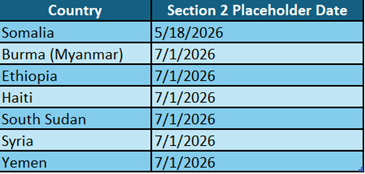
How to Complete New Hires’ Forms I-9 and Run E-Verify Cases During Court-Ordered Stays
Section 1 (Employee): For the Work Until Date, follow USCIS’s instruction: “as per court order”.
Section 2 (Employer): Enter the placeholder date for the country and add a brief note in the Additional Information box. USCIS does not specify what language to use, but consider noting “TPS-related litigation stay.”
E‑Verify: When prompted for a work authorization expiration date, enter the same placeholder date used in Section 2.
Reminders for Employers
As of this writing, USCIS still has not issued direct, consolidated guidance that addresses how employers should handle reverifications for existing employees with TPS-related work authorization impacted by litigation. As discussed in our previous update, employers may continue to rely on litigation-based extensions and continue to employ individuals who rely on TPS for their work authorizations. Employers may choose to update Section 2 or Supplement B, where applicable, annotate the Additional Information box, or wait for further guidance and track in some other way.
Regardless of the approach taken, maintaining compliance requires consistent application of the chosen strategy across similarly situated employees, clear documentation supporting the rationale for that approach, and continued monitoring of court activity and USCIS guidance.
For more information contact the authors directly. Seyfarth’s Immigration Compliance & Investigations specialty group is recognized as a national leader in the field. Trusted by Fortune 100 companies and small businesses nationwide, the team provides strategic, practical guidance across the full spectrum of immigration compliance. The group advises on Form I-9 and E-Verify compliance including electronic I-9 matters; ICE inspections and worksite enforcement actions; internal immigration assessments and I-9 audits; DOL immigration-related wage and hour investigations; H-1B/LCA compliance; and DOJ’s IER and OCAHO anti-discrimination matters, including foreign sponsorship “America First” and export control/ITAR issues.
*Selene Malench is a Case Assistant on Seyfarth’s Immigration Compliance & Enforcement team. Many thanks for her contribution to this legal update.