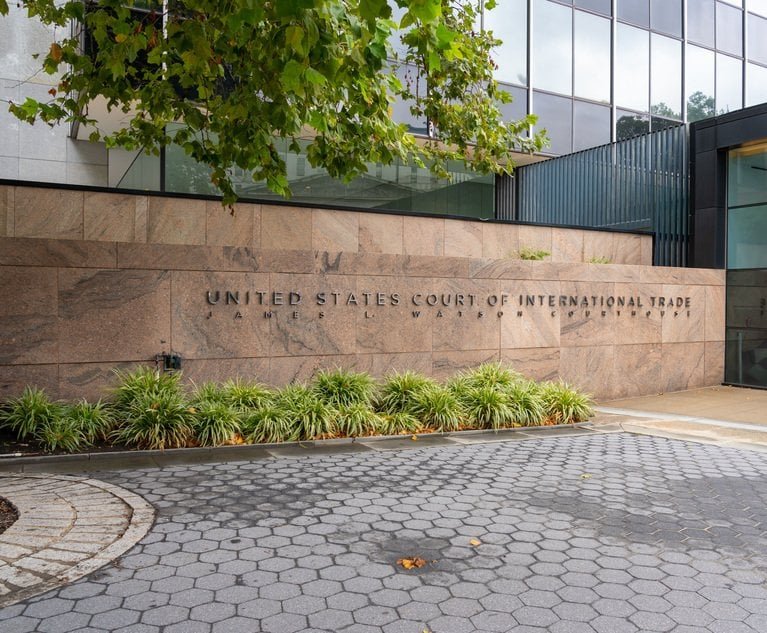
The U.S. Court of International Trade appeared skeptical of the Trump administration’s asserted authority to unilaterally order new tariffs in a recent hearing on the president’s trade orders, but questioned what type of relief they could provide to importers.
On Wednesday afternoon, Judges Gary Katzmann, Timothy Reif and Jane Restani posed highly technical questions to attorneys from the Trump administration and from the Office of Oregon Attorney General Dan Rayfield, who is leading a group of states challenging executive orders that raise tariffs on products from virtually the whole world.
President Donald Trump issued the orders under the International Emergency Economic Powers Act, a statute that lets the president “regulate… importation” to address “any unusual and extraordinary threat.” For his orders, Trump cited the amount of fentanyl entering the U.S. from Canada and Mexico, as well as the U.S. trade deficit.
The judges offered no clear answers on when, or how, they would rule, but several lines of questioning indicated that they weren’t buying federal attorneys’ arguments that Trump can exercise IEEPA mostly free of judicial oversight.
Here are key takeaways from the hearing:
As in a prior hearing last week, the U.S. Department of Justice—this time represented by Brett Shumate, the acting assistant attorney general for the DOJ’s Civil Division—outlined a system in which the court had little oversight over the president’s use of IEEPA.
Per Shumate, the court may only decide whether IEEPA grants the president the power to issue tariffs, which the administration finds to be the case. But the court cannot review whether Trump had established that rising fentanyl imports and the trade deficit are unusual and extraordinary matters, or whether the tariffs could feasibly address the issues, Shumate said.
“All of that is off the table, because it is Congress’s role to review the president’s compliance,” Shumate said. “There are a number of procedural checks on the president. He has to consult with Congress, submit reports to Congress and that report has to explain what he did, why he did it, why it complies with the statute.”
But the emphasis on Congress’s role had Restani questioning whether the court had received a copy of the report.
“I don’t know,” Shumate said.
“If there’s no report to Congress. Is this all void?” she asked.
“No, Your Honor. The court is not in a position where it reviews the president’s compliance with IEEPA,” Shumate said. “The court can only… decide what the statute means.”
She attempted to sum up the administration’s position: “Nothing is so crazy or unrelated that it could be stopped by the courts. Anything is allowed. Anything crazy. Any declaration of emergency, based on some crazy thing. Any remedy, as crazy as it could be—it’s all okay, because the courts can’t do anything.”
Restani later clarified that she hadn’t meant to call the executive orders crazy, but to offer an example unrelated to foodstuff, presumably, peanut butter.
But Shumate recoiled at her understanding of the administration’s defense.
“I would not go that far, Your Honor,” he said. “I’ve conceded you can review the interpretive question if the president–”
“Okay, but that’s all you’ve got,” Restani cut him off. “All you say the courts can do is look at the statute, but the courts cannot decide that this particular action, based on this particular declaration,n is way outside what Congress intended.”
What Can The Trade Court Do? And For Whom?
While much of the hearing was devoted to the limits of presidential authority, the judges delved into two key procedural issues towards the end of the proceeding—what type of relief they could order, if they side with the states, and which parties have established standing.
Brian Marshall, the senior assistant attorney general for Oregon, suggested the court could declare the tariff orders ultra vires, vacate the customs bulletins implementing the orders and issue a permanent injunction.
“A permanent injunction is necessary to remedy the state’s injuries here, because the state’s injuries here include situations where we are not the… importers of record,” he said. “We purchase from some other importer. If that importer, three years from now gets a refund, the states aren’t going to see any of that. The only way to really remedy the injury that we are facing is to provide us with an injunction.”
The inquiry, however, led to a question about standing, with Katzmann saying there could be an issue as to whether non-importer states should be dismissed from the case.
But Marshall argued that the states, as indirect purchasers of the products, have experienced the type of financial injuries required to establish standing.
“There’s a clear economic logic to this,” he said.
Shumate later argued that, if the states won, any potential relief should be limited to the suing, importing states and shouldn’t extend to their citizens. That contention drew skepticism from Restani, who referenced the states’ arguments that they faced more than an import injury.
“I’m not sure how you fashion relief short of a broad injunction,” she said.
“An injunction would be extremely disruptive while the president is in the middle of foreign negotiations with other countries… an injunction would completely kneecap the president at a delicate time,” Shumate said.
“Well, if the president isn’t doing something he’s not allowed to do by statute… the court can’t say, it’ll be better politically for the president to do this, but he’s not allowed to do it by statute, so therefore we allow it. I don’t think we can do it that way,” she said.
While some tariff challengers had filed their cases directly to the trade court, other critics sought different venues, including a stationary company that is backed by the New Civil Liberties Alliance, the same non-profit organization that helped convince the U.S. Supreme Court to overturn the doctrine of Chevron deference.
The alliance had filed their case, captioned Emily Ley Paper Inc. v. Trump, in the Florida federal court, arguing that IEEPA cannot support duties and doesn’t fall under the trade court’s exclusive jurisdiction over tariff statutes. Before Wednesday’s hearing, the Florida court transferred Emily Ley to CIT, stating, among others, that IEEPA authorizes tariffs.
That entire proceeding seemed to strike a sour note with the trade court.
“It seemed to me that the parties got the judge there involved in merits determination when it wasn’t necessary,” Restani said.
Marshall was quick to agree.
“Good, because otherwise there’d be a giant circle going on, depending upon how the decisions come out,” Restani said.
The trade court had previously voiced some frustration over the overlapping litigation filed across the country. During an earlier hearing also concerning the new tariffs, Katzmann stressed the importance of the case being heard in the trade court, the court with “exclusive jurisdiction.”