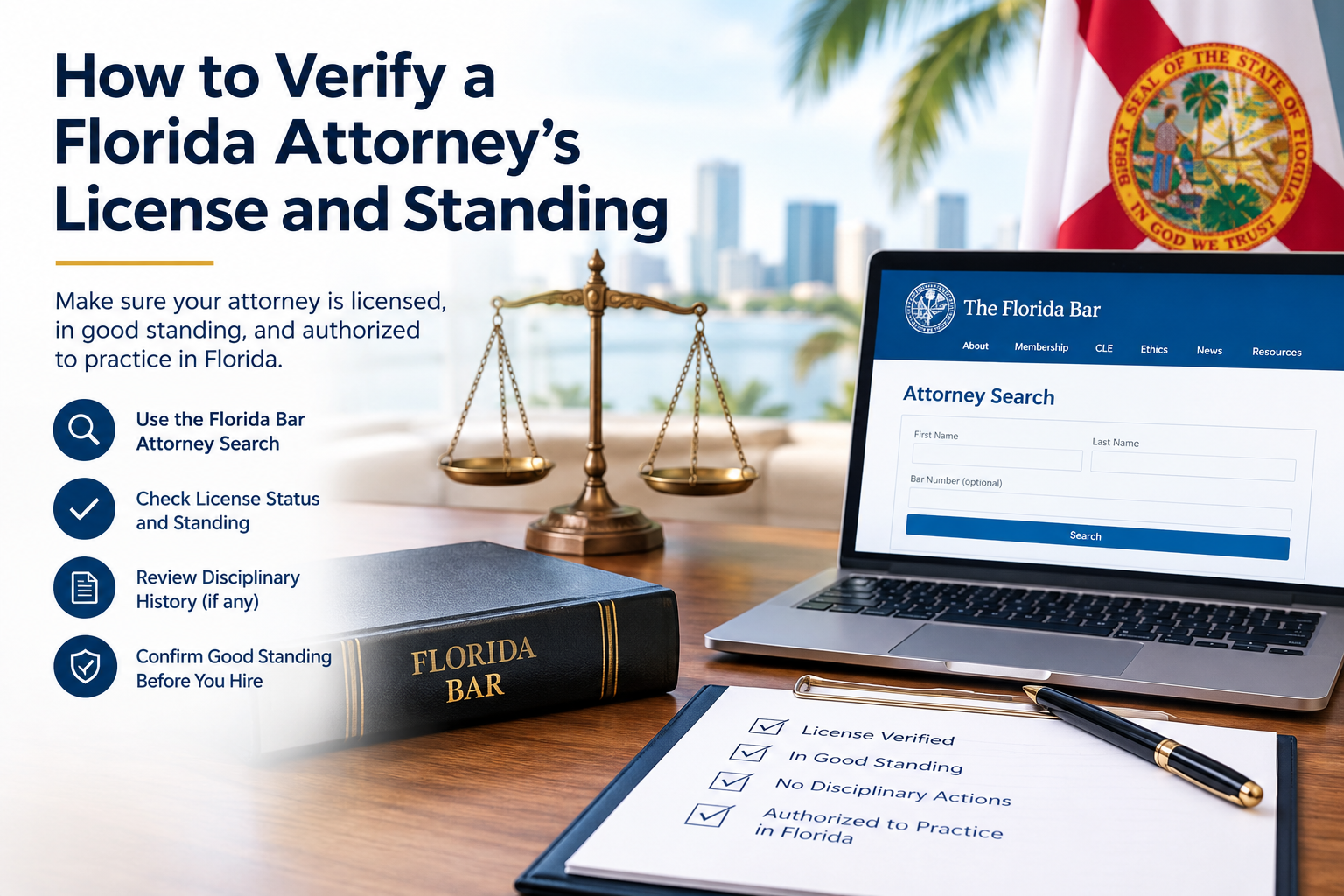
Before sharing sensitive information, signing a fee agreement, or relying on legal advice, confirm that the person you plan to hire is authorized to practice in Florida. A professional title, past courtroom experience, or a law degree does not by itself establish current authorization. Someone may have practiced law previously, worked in another state, or gained legal experience in a different role while not being eligible to represent clients in Florida now. Checking status is therefore a sensible first step, rather than an assumption based on a website, referral, or confident introduction.
Verification involves more than finding a name in a directory. Confirm that the individual is a member of The Florida Bar and review the person’s current eligibility to practice. Also check the available disciplinary information and whether any restrictions, conditions, suspension, or other limits affect the person’s ability to provide legal services. These are related but distinct questions: membership identifies a connection to the Bar, while eligibility and standing indicate whether practice is currently permitted and whether formal measures may apply. When considering how to check attorney license in Florida, look for current, official records and ensure that the result refers to the same person, not merely someone with a similar name.
This check is a practical safeguard for clients, prospective clients, and anyone asked to rely on legal guidance. It can help prevent confusion about who may appear on a matter, advise a client, or handle legal documents, and it gives you an opportunity to ask informed questions before proceeding. If a record shows a restriction or an unclear status, seek clarification directly from the appropriate official source before engaging the person for legal representation. Verification does not measure an attorney’s intelligence, experience, communication style, or suitability for a particular case. A lawyer may be fully authorized yet not be the right fit, just as a positive personal impression cannot substitute for confirming authorization. Treat the status check as one basic part of careful selection, alongside evaluating relevant experience, fees, and your comfort working together.
When learning how to check attorney license in florida, begin with The Florida Bar’s official website. Its lawyer search or member directory is the primary source for confirming whether a person is admitted to practice in Florida and reviewing the Bar’s available record. Use the search tool linked from the Bar’s website rather than an advertisement or an unrelated directory that appears in search results. Starting with the official source reduces the risk of relying on information that has been copied, misreported, or left out of date.
The directory generally allows searches by an attorney’s name, and a Bar number can help distinguish people with similar names. Depending on the record, results may display the lawyer’s business location, contact details, practice information, and current status. Review the returned details carefully and compare identifying information, such as the office location, with what you already know. If a name search produces several possible matches, use additional information or the Bar number to identify the correct record instead of assuming the first result belongs to the lawyer you are researching.
Pay particular attention to the status shown in the official listing, and read any accompanying explanations or links provided by The Florida Bar. A directory entry is a useful verification starting point, but readers should not treat brief profile details as a complete assessment of an attorney’s experience, suitability, or current availability. For questions about what a status means or how to interpret information in a record, consult the Bar’s explanatory resources or contact the organization directly through its published channels.
Commercial lawyer directories, search-engine listings, and an attorney’s own website or profile may be useful for general background, but they are not substitutes for the official Bar record. Third-party pages can retain outdated addresses, practice descriptions, or licensing details after a change. Check The Florida Bar’s directory directly, especially before hiring counsel or relying on a claim about licensure. If the directory does not provide enough information to confirm identity or standing, seek clarification from the Bar rather than drawing conclusions from an incomplete listing.
To learn how to check attorney license in florida, begin with the Florida Bar’s official attorney directory. Search the lawyer’s full legal name, including any suffix such as Jr. or III, because small differences can affect results. If you know the attorney’s Florida Bar number, enter it instead; this unique identifier is generally the most direct way to locate a matching profile. Use available filters, such as city or status, but avoid relying on a single search format alone. If the first query produces several entries or no clear match, refine the search before deciding whether the directory contains the attorney’s record.
When multiple lawyers have similar names, compare the directory details with information you already have. Check the listed city and office location, firm affiliation, practice areas, and other identifying details, such as a middle initial or suffix. A matching name by itself is not enough to confirm that a profile belongs to the person you are researching. Review the attorney’s public website or professional materials and see whether the location and firm correspond. If important details differ, do not assume the directory entry is the right person; continue checking identifiers or contact the attorney’s office to clarify. This careful comparison helps prevent confusion between separate lawyers.
If your search returns no result, first check for spelling errors, alternate spellings, hyphens, and differences in name order. Try searching without a middle name, then with a middle initial, or use the Bar number if available. You can also ask the attorney directly to provide their Florida Bar number and verify it in the directory. A missing result alone does not establish that someone is unlicensed or ineligible to practice: the search may be formatted incorrectly, or the person may be licensed in another jurisdiction rather than Florida. Confirm the identifying information and licensing jurisdiction before drawing conclusions about the attorney’s status.
When reviewing an official Florida Bar record, look for confirmation that the individual is admitted as a member of The Florida Bar and check the separate information about eligibility to practice. A name appearing in the directory is not, by itself, proof that the person is currently authorized to provide legal services. The record may identify someone who was admitted in the past but whose present status does not permit practice. For anyone researching how to check attorney license in florida, these two details—admission and current eligibility—are central to interpreting the listing.
Read the status label exactly as displayed, including any category or qualification. Labels can describe different circumstances, such as an active membership, an inactive membership, or another administrative or professional status. These categories are not interchangeable, and a person may remain a Bar member without being eligible to practice law. Do not infer that a label means “active” or “in good standing” unless the Bar’s own explanation supports that interpretation. If the entry uses unfamiliar wording, consult The Florida Bar’s status definitions and member information, or contact member services for clarification. Avoid relying solely on search-engine snippets, third-party directories, or an attorney’s own description when the official record is available.
Eligibility is a point-in-time record and can change. A status that was accurate when you first searched may not remain accurate later, so verify it again close to the date you plan to hire the attorney or begin a legal engagement. This is particularly prudent if there has been a delay between an initial consultation and signing an agreement, or if the public profile contains a qualification that you do not understand. Save or note the date of your check and, where appropriate, ask the attorney to explain any discrepancy between the official profile and information provided to you. Confirming admission and current practice eligibility does not assess an attorney’s skill or suitability for your matter, but it helps establish whether the person’s recorded status permits practice in Florida at that time.
When learning how to check attorney license in florida, review more than the lawyer’s current status. The Florida Bar’s public directory may include links or details about formal disciplinary actions. Depending on the record, these may disclose public sanctions, suspensions, disbarment, or other official measures. A clean or active listing does not necessarily provide a complete account of a lawyer’s professional history, so follow any available links to the underlying documents rather than relying only on a summary label.
Open the relevant orders, case summaries, or other official records and note the dates, the conduct addressed, and the final outcome. Check whether a suspension or other restriction is still in effect, has ended, or was later modified. Pay attention to whether the record describes an interim measure, a final decision, or a condition attached to the attorney’s ability to practice. If the wording is unclear, use the official source’s explanatory materials or contact the Florida Bar for guidance instead of drawing conclusions from a brief directory entry.
Formal discipline should be distinguished from an allegation or complaint. Complaints may not be public, may be screened out, or may not result in a finding of misconduct; an allegation alone does not establish that a lawyer violated professional rules. Conversely, a public disciplinary result should be read in its context, including the circumstances and timing, rather than reduced to a single label. A disciplinary history can help provide perspective when choosing counsel, but it is not a complete measure of competence, judgment, or suitability for a particular matter. Consider it alongside the attorney’s relevant experience, communication, and the needs of your case. If a record raises questions about current eligibility or restrictions, verify the present status with the Bar before retaining the lawyer.
When considering how to check attorney license in florida, distinguish admission to the state bar from a lawyer’s current authority to practice. Admission to The Florida Bar generally means the attorney has been authorized to practice law in Florida. However, that authorization is subject to the lawyer’s present status and any conditions, suspensions, or other restrictions shown in official records. A name appearing in a directory is not, by itself, proof that the person may currently handle every matter or provide every service.
A Florida license is also not a nationwide credential. A lawyer admitted in Florida is not automatically authorized to practice in another state, where separate licensing rules apply. Likewise, an attorney licensed elsewhere does not become Florida-licensed merely by representing a client whose case involves Florida, or by working remotely from another location. Rules about where legal work may be performed can depend on the jurisdiction, the type of matter, and the lawyer’s role.
There are circumstances in which an out-of-state attorney may provide limited legal services connected to Florida. For example, a lawyer admitted in another jurisdiction may seek permission to appear in a particular Florida court matter, often with requirements that include association with Florida counsel. Other limited-service provisions may apply in specific situations. These exceptions do not amount to general admission to practice in Florida. Ask the attorney to identify the rule or authorization that applies and clarify the services it permits; verify the details with the relevant court or official source when appropriate.
Finally, a valid license establishes authorization to practice within its scope, not expertise in every field of law. Attorneys may focus on particular types of cases, and experience can vary. Alongside reviewing licensing status, ask about the lawyer’s work with matters similar to yours, relevant training, and approach to the legal issue. Confirm who will handle the work and whether any limits apply to the representation. This combination of status checks and informed questions offers a more complete basis for deciding whether an attorney is suitable for your needs.
A directory entry can confirm that an attorney is listed, but it may not explain a recent change in status or a restriction on practice. If you are learning how to check attorney license in Florida and have concerns about a suspension, reinstatement, probation, or other condition, look beyond a name-and-address listing. Status can change, and a general directory may not provide the detail needed to understand whether an attorney may handle a particular matter.
Consult the official record for notices, disciplinary orders, court decisions, and other documents describing the attorney’s status. Read the operative language rather than relying only on a short summary or a status label. An order may specify when a restriction begins or ends, require conditions before reinstatement, or limit practice in a particular way. Check the date of the latest information and whether later notices or orders modify an earlier decision. Older documents can remain relevant as history, but they may not describe the attorney’s current standing.
If the record is unclear, contact The Florida Bar and ask how to interpret the official information. Provide the attorney’s full name and, if available, Bar number, and identify the document or status you are asking about. Do not assume that a term such as “reinstated” means every prior restriction has ended, or that a public listing alone establishes authority to act in a specific case. The effect of a restriction may depend on its exact wording and the legal work involved. Only official sources can confirm whether a restriction currently applies and what it means for a particular legal matter. When a decision depends on that answer, seek clarification directly from the relevant official office before proceeding.
If an online search does not show a clear answer, or the information appears incomplete, contact The Florida Bar directly rather than relying on third-party directories or search snippets. Use the Bar’s official website to find its current phone number, contact form, mailing address, and instructions for public-records inquiries; contact details and procedures can change. The official site is the best source for deciding which channel applies to a question about a lawyer’s license status or disciplinary history. Explain briefly what you have already checked and identify any result that seems inconsistent, outdated, or difficult to interpret.
Before contacting the Bar, prepare the attorney’s full name and, if available, Florida Bar number. Include the name as it appears in the public directory, any alternative spelling or former name you encountered, and the page or record where the uncertainty arose. State the precise question: for example, whether a displayed status means the attorney is currently authorized to practice, how to understand a status label, or where to locate official discipline information. If you are asking about a particular public entry, quote its wording rather than paraphrasing it. Clear, specific details help staff direct your inquiry to the appropriate resource and reduce confusion between similarly named attorneys.
If the public record appears inconsistent with what the attorney or another source has told you, ask The Florida Bar how to interpret the official entry or where to confirm the relevant information. Do not treat informal assurances as a substitute for clarification from an authoritative source. Keep a note of the date of your inquiry, the information you provided, and any response or referral you receive; this can help you follow up if the issue remains unresolved. When deciding how to check attorney license in Florida, use the official public record and the Bar’s guidance, especially when status information is unclear. This verification process can help you understand licensing and discipline records, but it is not legal advice about your matter and does not assess an attorney’s suitability for a particular case. Consult a qualified lawyer about case-specific legal questions.
Use the results of an official Florida Bar lookup as one part of a broader hiring checklist. First, confirm that the attorney’s name and identifying details match the person you intend to hire, and verify that the license is active and that no status or disciplinary information raises concerns. Save the result or note the date you checked it, along with any relevant details. This record can help you know when to repeat the search, particularly if your case continues for an extended period.
Next, assess whether the lawyer’s experience fits your legal issue. Ask about their work on matters similar to yours, the types of clients they typically represent, and what challenges or likely next steps they anticipate. A general claim of experience may not tell you whether the attorney has handled your specific kind of dispute, transaction, or proceeding. Ask direct questions and consider whether the answers are clear and relevant to your circumstances.
Clarify who will be responsible for the day-to-day work. The attorney you meet may delegate research, document preparation, or routine communications to associates or staff. Ask who will contact you, who will appear at hearings or meetings, and how you can reach the lawyer when an important decision is needed. Discuss expected response times and how often you will receive updates so that communication expectations are understood on both sides.
Before proceeding, discuss fees and other potential costs, including how billing works, what services are covered, and what might require an additional charge. Request the engagement terms in writing and review them before signing. Knowing how to check attorney license in Florida helps confirm an essential baseline: the lawyer is authorized to practice. It does not, by itself, establish competence, communication quality, or suitability for your needs. Consider those factors separately, and recheck the official record if the representation lasts a long time or circumstances change.