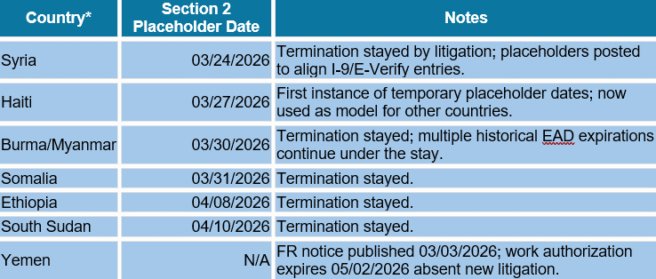
This week, U.S. Citizenship and Immigration Services (USCIS) sent email alerts and added guidance on the E‑Verify What’s New area on their website establishing dates for Form I‑9 Section 2 (and related Section 1 notations) for Temporary Protected Status (TPS) countries with terminations stayed by litigation. As discussed in our prior blog, USCIS for the first time a provided temporary date for Haiti; the agency now appears to be continuing this approach.
Importantly, the dates shared by USCIS are temporary placeholders rather than new work authorization validity periods. In fact, work authorization for all these affected countries continues with no actual end date. This is because the courts have stayed the terminations for now and related litigation is pending at the Supreme Court.
TPS Countries and Section 2 Placeholder Dates
Note: While TPS related work authorization has ended for most TPS Venezuelan beneficiaries, please see our prior blog for the very limited exceptions.
How to Complete New Forms I‑9 and Run E‑Verify During the Court-Ordered Stays
New hires (covered TPS + litigation stay)
Section 1 (Employee): Follow USCIS’s instruction: “as per court order”.
Section 2 (Employer): Enter the placeholder date for the country and add a brief note in the Additional Information box. USCIS is not specific on what to add, but consider noting “TPS-related litigation stay”
E‑Verify: When prompted for a work authorization expiration date, enter the same placeholder date used in Section 2.
What Employers Should Do Now
There is still no direct and consolidated USCIS guidance for existing employees. Based on the court‑ordered stays and the placeholder framework, employers may continue to rely on litigation‑based automatic extensions and continue to employ individuals from the affected TPS countries.
USCIS has not provided direction on how employers should handle existing employees whose Forms I‑9 were completed under earlier TPS instructions. There is no clear answer on whether Section 2, or in many cases Supplement B, should be updated, whether employers should simply annotate the Additional Information box, or whether employers should wait for future guidance.
In the absence of explicit instruction, employers must adopt a reasonable and consistent approach to avoid premature termination and reduce the risk of unauthorized employment, if TPS is ultimately terminated by the courts. One reasonable approach is to update the Form I‑9 with the new placeholder date USCIS has provided. Another option is to choose a later, easily identifiable date for internal tracking. A third option is intentional inaction for now: maintain the existing Form I‑9 without updating dates, provided you create a contemporaneous memo to file explaining the litigation posture, the absence of clear guidance from USCIS, and your monitoring plan; apply this approach consistently; and actively track court developments and USCIS updates to trigger action if the stay changes. This inaction approach should be defensible given the frenetic, evolving guidance and the lack of a solid litigation‑linked end date, but it requires vigilant tracking, clear documentation, and prompt reverification if circumstances change. The key point across all options is disciplined monitoring of dates and court activity and documenting the rationale behind the approach you adopt.
Electronic I‑9 System Limitations
How updates are handled outside a paper Form I‑9 will depend on the capabilities and constraints of the electronic I‑9 system in use. In many cases, a Supplement B may be required to record the update. Any additional tracking mechanism, whether within a HRIS or another internal tool, should be developed in consultation with experienced immigration compliance counsel to ensure the structure is compliant and defensible as employers make choices in the current guidance gap. Regardless of your choices, document the approach and monitor USCIS webpages regularly.
While some vendors are scrambling to develop technical solutions, others are not offering any such solutions. Additionally, most electronic I‑9 platforms cannot accommodate nonstandard language such as “as per court order” or override automated expiration date fields. These systems were never designed for litigation‑driven extensions or irregular agency directives. As noted above, it also remains unclear what USCIS expects employers to enter in the Additional Information box.
For employers with large TPS‑impacted populations, attaching individual USCIS alerts to every electronic Form I‑9 is rarely practical, and many systems do not allow supplemental uploads in the necessary fields. When possible, employers may upload the alert into the employee’s document section, pair it with a paper Form I‑9, or maintain a separate TPS reference binder. Tracking affected employees remains essential, as continuing to employ individuals who ultimately lose work authorization carries significant compliance risk.
Litigation Snapshot
The Supreme Court has now taken up the consolidated Haiti and Syria TPS cases and scheduled oral arguments for the end of April. The Court declined to lift the lower‑court stays, so the injunctions blocking termination remain in place while the justices hear the matter. Briefing runs through late March and mid‑April, with a single hour of argument set during the Court’s April argument calendar. Until the Court rules, which is expected by late June or early July, the stays remain active and work authorization for individuals from Haiti and Syria continues uninterrupted.
Other Reminders
Yemen is the exception; its TPS designation has been terminated and, absent new litigation, work authorization is scheduled to expire on May 2, 2026.
For more information contact Alexander Madrak or Dawn Lurie directly. Seyfarth’s Immigration Compliance & Investigations specialty group is recognized as a national leader in the field. Trusted by Fortune 100 companies and small businesses nationwide, the team provides strategic, practical guidance across the full spectrum of immigration compliance. The group advises on Form I-9 and E-Verify compliance; ICE inspections and worksite enforcement actions; internal immigration assessments and I-9 audits; DOL immigration-related wage and hour investigations; H-1B compliance; and DOJ’s IER and OCAHO anti-discrimination matters, including foreign sponsorship and export control/ITAR issues.