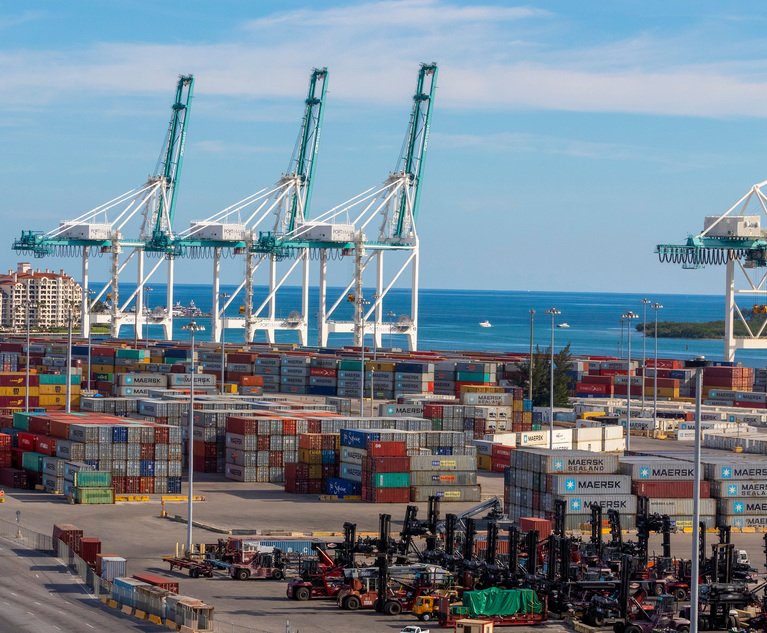
President Donald Trump’s announcement this week that he will impose sweeping new tariffs, including a 34% tax on imports from China and 20% tax on imports from the European Union, will give U.S. businesses their biggest test since COVID-19 upended consumer demand and threw global supply chains into disarray five years, corporate lawyers say.
One big challenge is that so many variables are at play. Will Trump hold firm to the increases or backpedal? And will foreign nations targeted by the levies respond by rolling back their tariffs and moving manufacturing to the U.S.—as Trump predicts—or merely roll out retaliatory tariffs in an ever-escalating trade war? And will courts validate the president’s authority to impose the tariffs or find he’s exceeded the bounds of his power (as they have in a host of other matters)?
Law.com rounded up this advice from lawyers and consultants expert in the realm of international trade:
“Bringing together the relevant cross-functional business stakeholders with tariff experts makes it easier to review tariff situations and quickly execute effective mitigation tactics.”
A top priority for those in the war room should be evaluating manufacturing capabilities, supplier footprints and supply chain options to minimize tariff exposure, Alix Partners said.
Also critical, the firm said, is determining which costs to absorb and which to pass on to customers.
“The threat is severe, and companies that act decisively and deliberately will have the upper hand in a competitive landscape,” Alix Partners said.
>>Don’t bet on any one outcome.
“Rather than assuming any one country is a safe haven, companies should try to adopt a diversified strategy that balances reshoring, near-shoring and offshore production, the law firm Harris Sliwoski told clients.
“Our international trade lawyers have prevented multiple companies from facing steep fines and unexpected tariffs after they incorrectly assumed that because their Chinese manufacturer’s product was shipped from Vietnam or Cambodia, it was no longer considered ‘Made in China’ under U.S. trade law,” Harris Sliwoski said in its client advisory. “This assumption is a major compliance risk.”
The law firm said that companies that make missteps can be declared ineligible for U.S. government contracts and can face fines of up to four times the amount of duties owed.
In addition, company executives can be criminally prosecuted and sentenced to prison.
The attention to detail also must extend to reviewing nitty-gritty contract language. One key issue is whether a contract provides an opportunity for a renegotiation that would factor in tariff-related cost increases.
Another is which party the contract saddles with responsibility for paying tariffs. For a product coming from Australia, for instance, would the Australian exporter be on the hook, or would it be the U.S. importer?
Finally, making the right decisions requires an understanding of the political environment on the ground in foreign nations. For example, Harris Sliwoski noted that Vietnam, Cambodia, Bangladesh, Thailand and Taiwan—which Trump hit with tariffs topping 36%—”are expected to scramble” to lower their tariffs.
On the other hand, Japan and South Korea, which the president hit with tariffs topping 24%, “have maintained high tariffs for decades. Quick changes are unlikely.”
Companies should be prepared for every eventuality and not let themselves get caught on their heels, law firms say.
The firm also urged clients to “implement a risk management framework to quantify the financial and operational impact of new tariffs and adjust sourcing and investment strategies accordingly.”
Also crucial, Morgan Lewis said, is creating a communication plan that keeps customers informed about price increases and potential disruptions, ensuring transparency in supply-chain cost adjustments.
Because Trump has long advocated for tariffs and championed them during his first term as president, companies have had years to prepare for this moment.
Alix Partners praised Cisco, the maker of computer-networking gear, for dramatically reducing its exposure to tariff risks.
On a conference call with analysts in February, Cisco Chief Financial Officer Scott Herren said the company already has cut its tariff exposure for goods and materials made in China by 80% and was preparing to do more.
Supply Chain Dive said Cisco has nine global manufacturing sites, three logistics operations and four dual manufacturing and repair facilities—four of which are in China.
To further diversify its supply chain, the company began manufacturing and repair operations in India in 2023.
“We’ve game-planned out several scenarios and steps we could take. Depending on what actually goes into effect, we’ll start to take those steps to mitigate the impact of the tariffs,” Herren said during the February call.
Alix Partners said of Cisco: “We believe this is a winning strategy—acting decisively with proven tactics will best mitigate tariff impacts and protect customers from price increases.”
While Harris Sliwoski advocates the same approach, partner Dan Harris said in a blog post that pure chance also will play a role in sorting out winners and losers.
He noted that while Trump slammed Vietnam and Cambodia with nearly 50% tariffs, he spared Mexico from paying new tariffs (generating intense speculation as to why) and assessed Peru with just a 10% tariff.
“I’ve already heard from clients panicking over tariffs from Vietnam and Cambodia, while others feel vindicated by their decision to manufacture in Mexico and Peru,” he wrote. “Some companies got incredibly lucky. Others are suddenly in deep trouble.”